
Reviewed · WALKING TOURS
Nuns and Nazis Walking Tour in Salzburg
Salzburg’s movie magic has a darker side. The Nuns & Nazis Walking Tour connects the familiar Sound of Music locations with the less comfortable story of Salzburg during World War II. I like the way it links the Trapp family, film history, Jewish families, forced labor, and the Nazi takeover without treating them as separate subjects. I also like the personal touch from guide Leo, whose own family history was shaped by the war. The main drawback is the pace: the tour is scheduled for about two hours to two hours and 15 minutes, but it can run longer, and much of it takes place outdoors.
This is not a standard introduction to Salzburg. It assumes you want a focused look at the war years, with only enough general city history to make each place meaningful. The small-group format, capped at 25 people, should make it easier to hear Leo, though you will still be walking and standing for most of the afternoon. Bring weather protection, and consider watching Sound of Music before you go.
In This Review
- Key points at a glance
- Why this Salzburg walk is different
- Starting among gardens and grand buildings
- Stolpersteine on Linzergasse
- The Staatsbrücke and the cost of construction
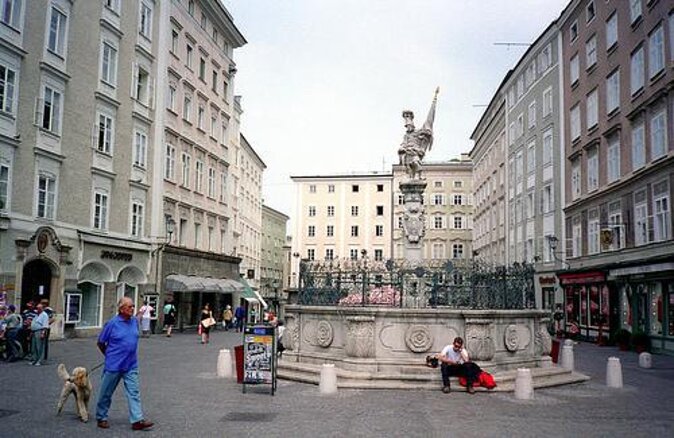
- Ordinary lives at Alter Markt
- The Festspielhaus and the Trapp family
- Residenzplatz and the Nazi takeover
- The climb to Nonnberg Abbey
- How much time should you allow?
- Is $20.64 a fair price?
- Who will get the most from it?
- Practical details before you go
- Should you book the Nuns & Nazis Tour?
- FAQ
- Where does the Nuns & Nazis Walking Tour start?
- What time does the tour begin?
- Where does the tour end?
- How long does the tour last?
- Does the tour include Sound of Music locations?
- Is the tour suitable for people with limited mobility?
- What is the cancellation policy?
Key points at a glance
- Two stories in one walk: Connect Salzburg’s famous movie locations with the city’s Nazi-era past.
- A personal guide: Leo brings family experience and strong knowledge of the Trapp family story.
- Nine central stops: The route crosses Mirabell Gardens, the old town, the Staatsbrücke, and Nonnberg Abbey.
- Important memorials: See Stolpersteine and hear about Jewish families, forced labor, prisoners of war, and Salzburg’s wartime book burning.
- A thoughtful final stop: The walk ends at Nonnberg Abbey, with views toward the Alps and a footpath toward Hohensalzburg Fortress.
- Plan for extra time: The official duration is about two hours to two hours and 15 minutes, but one account describes a tour lasting about three hours.
Why this Salzburg walk is different
Many Salzburg sightseeing walks give you the city’s broad outline: Mozart, baroque churches, the river, and the fortress. This tour takes a narrower route through the 1930s and 1940s, then uses The Sound of Music as a second thread.
That combination could sound odd at first. It works because Salzburg’s movie image is so cheerful, while the real city was living through one of Europe’s darkest periods when the Trapp family story unfolded. You move between gardens used in the film and streets where people faced persecution, conscription, forced labor, exile, or worse.
The tour does not present World War II as a dry list of dates. At each stop, Leo ties events to a physical place. That matters in Salzburg, where the old town can otherwise feel almost too polished and picturesque. A square, bridge, or narrow lane becomes easier to understand once you know what happened there.
Leo’s style is another reason to consider this walk. The strongest praise centers on his cheerful, engaging manner and his passion for Salzburg and its culture. He also appears willing to spend time on questions and follow the group’s interests. That warmth helps with difficult subject matter, though you should still expect a serious tour rather than a light movie outing.
More Walking Tours in Salzburg
- Salzburg 2.5-Hour Walking Tour: Mozart, Old Town & More
★ 4.2 · 987 reviews - Salzburg: Old Town, Mozart, & Mirabell Gardens Walking Tour
★ 4.8 · 461 reviews - Salzburg Oldtown: Sightseeing Walking Tour with Licensed Local Guide
★ 5.0 · 392 reviews
Starting among gardens and grand buildings
The tour begins at Kurgarten on Rainerstraße at 3 p.m. From there, the first stop is Schloss Mirabell and Mirabell Gardens, where you spend about 15 minutes.
The gardens are among the best-known filming locations connected with The Sound of Music. If you have seen the film recently, you may recognize the setting quickly. The value here is not only the photo opportunity. The gardens provide a gentle introduction to the tour’s two-part structure: a familiar, almost playful film location followed by the harder history that shaped Salzburg at the same time.
The admission is free, and no separate ticket is needed for the stops listed on the route. Since this is an outdoor beginning, rain or cold can affect your comfort. One experience took place on a rainy, cold day and still worked well because Leo kept the group engaged, but weather remains a practical concern.
At nearby Makartplatz, the tour spends about 10 minutes examining a square that changed names several times before, during, and after World War II. The surrounding buildings also carry traces of the period.
This is a good early stop because it shows how political change can appear in ordinary city details. A renamed square may seem minor beside the major events of the war, but public names reveal who held power and how a city tried to handle its past afterward.
Stolpersteine on Linzergasse
The route continues along Linzergasse, a neighborhood associated with ordinary residents rather than grand institutions. Here Leo introduces the Stolpersteine, small memorial stones set into the pavement for victims of the Nazi regime.
This may be one of the most affecting stops because the memorials are easy to miss when you walk alone. You are not simply hearing about persecution from a distance. You are looking down at markers placed within the daily life of the city.
The 10-minute stop is short, so do not expect a full study of every memorial. Its purpose is to show how individual names and lives fit into Salzburg’s wartime story. It also shifts attention away from famous figures and toward people who lived in these streets.
Next comes Steingasse, another 10-minute stop. Here Leo tells an urban legend involving a wartime trace in Salzburg and leaves you to decide how much of the story you believe.
That moment adds a lighter note without turning the subject into a joke. It also gives you a reminder that city history includes rumors, local tales, and uncertain evidence. A good guide should separate documented events from stories passed down over time, and the tour lets you consider that distinction directly.
The Staatsbrücke and the cost of construction
At the Staatsbrücke, Salzburg’s main old-town bridge, Leo explains that hundreds of prisoners of war and forced laborers worked on its construction during World War II.
The bridge is still part of everyday city life, which makes the story especially useful. You see the finished structure, then learn about the people who were compelled to build it. That contrast makes the meaning of forced labor concrete in a way that a general lecture often cannot.
You spend about 10 minutes here. The stop is not designed as an engineering tour, and the bridge itself is not the main attraction. The point is the human labor behind a familiar piece of infrastructure.
For me, this is the kind of detail that justifies choosing a focused war-history walk over a standard sightseeing circuit. Salzburg’s beauty can make the past feel distant. A working bridge brings that past back into the present.
More walking tours:
- Salzburg Old Town Walking Tour, Mozart, Mirabell Gardens
★ 4.5 · 201 reviews - Salzburg Old Town Highlights Private Walking Tour
★ 4.5 · 78 reviews - Salzburg Private Walking Tour
★ 4.6 · 48 reviews - Private Walking Tour of Salzburg
★ 5.0 · 42 reviews
Ordinary lives at Alter Markt
At Alter Markt, the old market square, the emphasis turns to common people and a Jewish family from Salzburg. Leo explains how people tried to escape the city, and what happened to those who did not get out before the Nazis took control.
The language here is intentionally personal. Instead of treating the Nazi takeover only as a national political event, the stop asks what it meant for families making urgent decisions in a particular city.
You spend around 10 minutes at the square. The information is connected to the people who lived in Salzburg, not just to the buildings around you. That makes Alter Markt one of the places where the walk moves beyond the Trapp family and the movie.
It is also where the tour’s title becomes clearer. The Nuns side offers recognizable Salzburg and Sound of Music connections. The Nazis side asks you to look at the same city through the experience of people who had far less freedom and safety.
The Festspielhaus and the Trapp family
At the Grosses Festspielhaus, you spend about 15 minutes learning about one of the most important links between the movie and real life.
The concert hall appears near the end of The Sound of Music, when the Trapp family performs before leaving Salzburg. The useful correction here is that the family really did perform at the Salzburg Festspielhaus. The film did not invent the entire connection, even though the movie changes details for dramatic effect.
This stop suits fans who know the film well, but it also works if you only remember a few scenes. One useful tip is to watch the movie again before the tour. Several locations appear only briefly, and knowing the scenes makes them easier to recognize.
The tour does not treat The Sound of Music as a complete historical record. That is important. You hear about the actual family, the film version, and the difference between them. If you expect every movie detail to be literally true, you may be surprised. If you enjoy seeing how a real story became a major film, this stop should be rewarding.
Residenzplatz and the Nazi takeover
Residenzplatz receives the longest scheduled stop, about 20 minutes. Here Leo covers the Anschluss, the Nazi takeover of Austria, more of the Trapp family story, the history of the film, and Salzburg’s only book burning during World War II.
This is the political center of the walk. The square gives the tour room to explain how the national takeover affected Salzburg and how the city responded. The book burning adds another local detail that can be easy to miss in a broad account of the period.
The variety of subjects can make this stop feel full. You move from political history to family biography, then to film interpretation and censorship. That is useful if you want a wide picture of the era, but it may feel dense if you prefer one subject at a time.
I would pay close attention to the distinction between the real Trapp family and the film’s version of events. The tour’s strength is not just pointing out filming sites. It is showing how movie memory can sit beside uncomfortable facts, sometimes accurately and sometimes with changes made for storytelling.
The climb to Nonnberg Abbey
From Residenzplatz, the route goes to Stift Nonnberg, with about 20 minutes at the abbey. Nonnberg is associated with the nuns in The Sound of Music, but it also has a much older identity as the oldest women’s monastery in the world.
The abbey is a fitting final stop because it brings the two themes together. You get the last set of Sound of Music facts and stories, while also standing at a place with a long religious history that reaches far beyond the film.
The route ends at Nonnberggasse 8, outside Nonnberg Abbey. The church is a worthwhile sight in its own right, and the location offers views toward the Alps. From here, you can continue on foot toward Hohensalzburg Fortress, making the ending practical for a longer afternoon walk.
The final section may be the most physically demanding part because the route leads uphill from the old town. A moderate level of fitness is recommended. The tour is not presented as a strenuous hike, but you should be comfortable walking between stops and remaining on your feet.
How much time should you allow?
The stated duration is about two hours to two hours and 15 minutes. The scheduled stop times add up to roughly two hours, before allowing for the walking between locations.
In practice, the tour can last longer. One account describes an experience of about three hours, while another says it lasted over two hours. That extra time may be welcome if you enjoy questions and detailed explanations, but it can affect dinner plans, museum visits, or a timed fortress booking.
I would keep at least three hours free from the 3 p.m. start. That gives you room for a longer explanation, a slower group, or a final pause at Nonnberg Abbey. You should also avoid booking another fixed activity immediately afterward.
The maximum group size is 25 people. That is not a private tour, but it is more manageable than a large city group. Since several stops involve narrow streets and busy public spaces, staying close to Leo will help you hear the details.
Is $20.64 a fair price?
At $20.64 per person, the tour offers good value if you want a focused guide rather than only a list of photo locations. Every stop on the route is free to enter, so you are paying for Leo’s time, research, storytelling, and the structure that links the sites.
That distinction matters. You are not buying admission to a museum or a special underground room. The value comes from interpretation. Without a guide, you might walk through Mirabell Gardens, cross the Staatsbrücke, and pass Nonnberg Abbey without understanding how they connect to the film and the war years.
The price is easiest to justify if you have an interest in both subjects. A dedicated World War II history enthusiast may find the Sound of Music material too prominent. Someone seeking only movie scenery may find the Nazi-era sections heavier than expected.
I like the balance because Salzburg’s movie image is impossible to ignore, yet the city deserves a fuller account than a series of cheerful singing locations. This tour makes you think about both.
Who will get the most from it?
I would recommend this walk to:
- People who want World War II history tied to real streets and buildings
- Sound of Music fans who want to separate fact from film
- Visitors who have already taken a general Salzburg walking tour
- Families with older children who can handle serious historical subjects
- Anyone interested in how cities remember difficult periods
It may not suit you if you want a relaxed, purely scenic stroll. The subject includes persecution, forced labor, Jewish families, book burning, and the Nazi takeover. The tone can be friendly and entertaining, but the content is not light.
The tour is also less useful if you have very limited time in Salzburg and need a fast overview of Mozart, the cathedral, and the fortress. This route gives priority to World War II and the Trapp family, not to every major city landmark.
Practical details before you go
The meeting point is Kurgarten, Rainerstraße 2, Salzburg, with a 3 p.m. start. The tour ends at Nonnberggasse 8 by Nonnberg Abbey, not back at the starting point.
A mobile ticket is provided, and confirmation is sent within 48 hours of booking, subject to availability. Service animals are allowed, and the route is near public transportation.
Because much of the experience takes place outside, dress for the forecast. Rain did not prevent one particularly positive experience, but cold or wet weather can make two to three hours on foot tiring. Comfortable shoes are sensible, especially for the route toward Nonnberg.
Free cancellation is available up to 24 hours before the start time for a full refund. Changes or cancellations made less than 24 hours before the start are not accepted for a refund.
Should you book the Nuns & Nazis Tour?
Book it if you want Salzburg to make more sense, not simply look pretty. The combination of Mirabell Gardens, the Trapp family, Stolpersteine, the Staatsbrücke, the book burning at Residenzplatz, and Nonnberg Abbey gives you a more honest picture of the city.
I would especially choose it after a general Free Walking Tour, since the two experiences serve different purposes. Guide Leo receives the strongest praise for being friendly, passionate, professional, and able to make serious material engaging.
Skip it if you want only Sound of Music photo stops, or if you cannot spare at least two and a half to three hours. For the right audience, though, $20.64 buys much more than a movie-location walk. It gives you a way to see Salzburg’s beauty without allowing that beauty to hide its past.
FAQ
Where does the Nuns & Nazis Walking Tour start?
The tour starts at Kurgarten, Rainerstraße 2, 5020 Salzburg, Austria.
What time does the tour begin?
The scheduled start time is 3 p.m.
Where does the tour end?
The tour ends at Nonnberg Abbey, at Nonnberggasse 8, 5020 Salzburg, Austria.
How long does the tour last?
The stated duration is approximately two hours to two hours and 15 minutes. It can run longer, so allowing up to three hours is sensible.
Does the tour include Sound of Music locations?
Yes. The route includes Mirabell Gardens, the Grosses Festspielhaus, and Nonnberg Abbey, along with other places connected to the Trapp family and the film.
Is the tour suitable for people with limited mobility?
A moderate level of physical fitness is recommended. The route involves walking between several city stops and continues uphill toward Nonnberg Abbey.
What is the cancellation policy?
You can cancel up to 24 hours before the start time for a full refund. Cancellations or changes made less than 24 hours before the start are not accepted for a refund.
Just added around Salzburg
- Salzburg & “The Sound of Music” Full Day Driver-Guided Tour★ 5.0 · 3 reviews
- MONDSEE: The Strudelgirl – bake your Apple Strudel Dream★ 5.0 · 3 reviews
- Zell am See Alpine Village Private Day Trip from Salzburg★ 5.0 · 3 reviews
- Salzburg “Sound of Music” Private Driver-Guided Tour★ 5.0 · 3 reviews
- Private Transfer from Salzburg to Vienna: Door-to-door, English-speaking driver★ 4.5 · 3 reviews
- From Vienna: Austrian Lakes and Salzburg Private Tour★ 5.0 · 3 reviews
- Salzburg für Salzburger★ 5.0 · 3 reviews
- Private Tour: Discover Salzburg and the Stunning Lake District★ 5.0 · 3 reviews
Walking Tours, compared.

Guided Walking Tour of City Center Highlights
Read our review →

Guided Walking Tour of City Highlights & Hidden Gems
Read our review →


Vienna Historic Center Small Group Walking Tour
Read our review →
Browse the lists this tour appears in