
Reviewed · WALKING TOURS
Private Klimt & Vienna Art Walk — From Baroque to Secession
Vienna’s art story is bigger than The Kiss. This private half-day walk links Gustav Klimt’s best-known works with the Baroque grandeur of the Belvedere, the rebellion of the Secession movement, and the city’s remarkable turn-of-the-century architecture. I like the small private format, which lets the guide adjust the pace and answer questions, and I like the way the route connects paintings to Vienna’s politics, buildings, and personalities.
The main caution is that this is a serious sightseeing walk, not a quick museum visit. You cover a lot of ground, and the entrance fees are extra. Guide Walter receives especially strong praise for his art and historical explanations, though one account found his presentation more like a lecture than a conversation. His personal political opinions can also enter the tour, which may suit some people and irritate others.
In This Review
- Key points to know before booking
- Starting at the Belvedere and meeting Klimt
- Reading Prince Eugene’s Baroque palace
- Schwarzenbergplatz and Vienna’s changing power
- Karlskirche and the peak of Vienna’s Baroque style
- Otto Wagner’s Karlsplatz station and the arrival of Art Nouveau
- The Musikverein and Vienna’s musical identity
- The Secession Building and Klimt’s Beethoven Frieze
- Naschmarkt, food, and a practical ending
- How much walking and public transport to expect
- The guide’s style and the private format
- Is $372.47 good value for your group?
- Who should book this Vienna art walk?
- Should you book it?
- FAQ
- How long does the tour last?
- What time does the tour start?
- Are museum admission fees included?
- Where can pickup take place?
- Is public transportation included?
- How many people can join the private tour?
Key points to know before booking
- Klimt’s The Kiss at the Belvedere: The Upper Belvedere is the central stop, with advertised skip-the-line access, but admission is not included in the price.
- Two major Klimt works: The tour pairs The Kiss with the Beethoven Frieze inside the Secession Building.
- Baroque to Art Nouveau: You move from Prince Eugene’s palace gardens and Karlskirche to Otto Wagner’s elegant Karlsplatz station.
- Private service for up to eight: Pickup is offered at hotels, vacation rentals, Vienna’s main train stations, or the Reichsbrücke pier.
- A flexible half-day: Morning departures begin at 9:30 and afternoon departures at 14:00, with a tour lasting about four hours.
- A walking and public transport mix: You need moderate fitness, and any metro fare is your responsibility.
Starting at the Belvedere and meeting Klimt
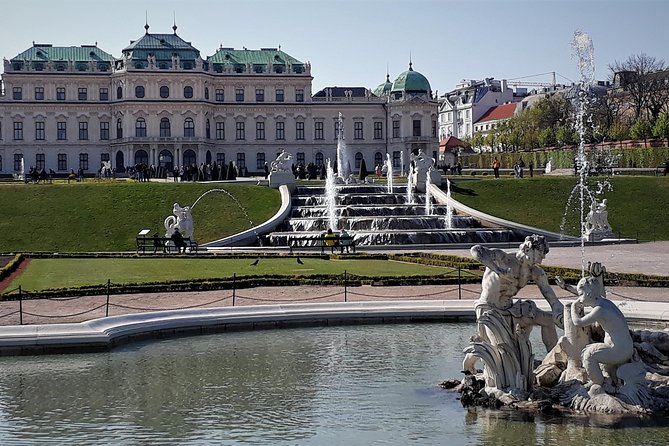
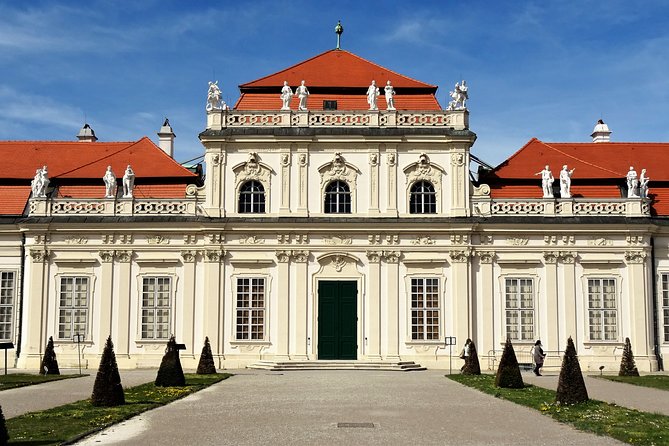
The tour begins at the Belvedere, Vienna’s grand Baroque palace complex. Its wrought-iron gates open onto formal gardens that rise toward the Upper Belvedere, giving you a fine first look at the palace before you even enter a gallery.
The gardens were designed to impress from a distance. Their three levels create a carefully arranged climb, with water features, statues, terraces, and changing views toward the palace and the city. Your guide explains how the garden uses perspective and visual tricks, making the approach part of the lesson rather than simple scenery between the entrance and the museum.
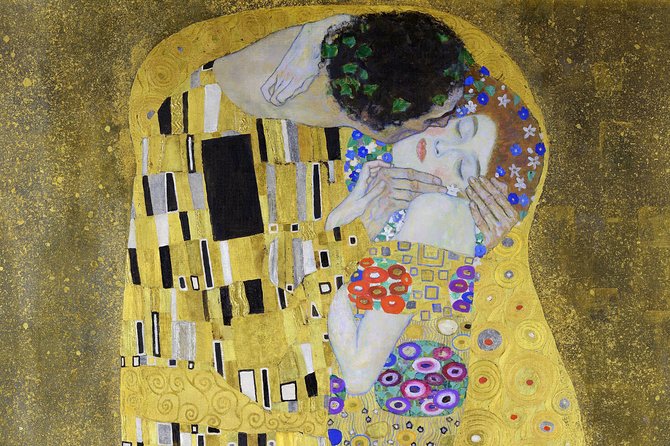
The great prize is Gustav Klimt’s The Kiss, housed in the Austrian Gallery at the Upper Belvedere. Seeing it here matters. You are not viewing an isolated reproduction in a crowded room with no context. You are looking at it in the palace built for a prince, surrounded by the artistic world that helped shape Vienna around 1900.
Klimt’s painting is famous for its gold surface, but a good explanation helps you look past the glitter. The patterned clothing, the contrast between the embracing figures, and the flat decorative design all point toward Vienna’s Art Nouveau period. This is where the guide’s art background can make a real difference. Several highly positive accounts praise the explanations of Klimt’s life, friends, and artistic setting.
The advertised visit includes skip-the-line access, a useful benefit at a major museum. Still, your admission ticket is not included. Check the booking details carefully and budget separately for the Upper Belvedere and the Secession Building. Skip-the-line service saves time, but it does not make the museums free.
The planned museum visit at the Belvedere is listed as about 40 minutes. That is enough to focus on Klimt and gain a clear sense of the palace, but it is not enough for a full museum tour. If you want extensive time with the entire Austrian Gallery collection, this experience will feel too brief. The point is to connect one major artwork to the city around it.
More Private Tours in Vienna
- Vienna: Private Walking Tour with a Local Guide
★ 4.6 · 1,420 reviews - Vienna: Private Walking Tour with a Guide
★ 4.7 · 962 reviews - Vienna: Wine Tasting Experience in a Private Wine Cellar
★ 4.8 · 413 reviews
Reading Prince Eugene’s Baroque palace
As you move down through the Belvedere grounds, the focus shifts from Klimt to Prince Eugene of Savoy, the military commander and collector who created this palace complex. The Lower Belvedere helps explain what he brought to Vienna from the courtly world of Versailles, though on a smaller scale.
The garden room and honor court are especially useful for understanding Baroque taste. Everything was designed to control the visitor’s view and create a sense of rank. You do not simply walk through a garden. You move through a planned display of power, with the palace positioned as the final reward at the top.
The route information says the group enters the Lower Belvedere, but the main timed museum visit is focused on the Upper Belvedere and The Kiss. Ask the guide how much interior time is planned on the day, since the exact balance can depend on museum conditions, walking speed, and the group’s interests.
This part of the experience gives the tour its useful historical shape. Klimt did not appear in a vacuum. Vienna’s imperial wealth, palace culture, churches, concert halls, and public institutions all helped create the city that later produced the Secession artists. The contrast between Prince Eugene’s formal Baroque world and Klimt’s decorative modernism is one of the best reasons to choose this walk.
Schwarzenbergplatz and Vienna’s changing power
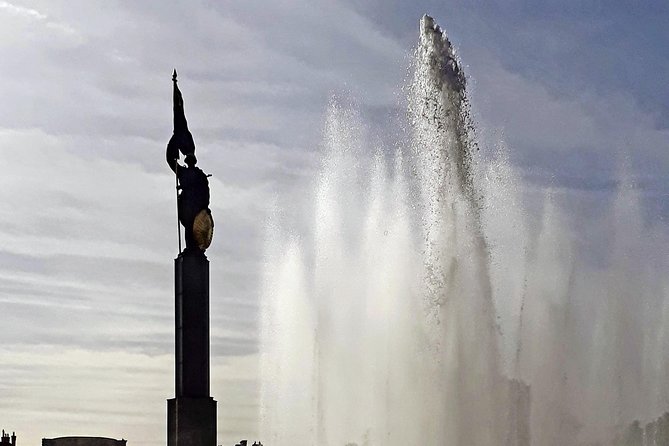
Leaving the Belvedere, the route reaches Schwarzenbergplatz. The Soviet Memorial dominates the square, while surrounding buildings reflect Vienna’s rapid growth at the end of the 19th century.
This is a good place to see how the city carries several political eras at once. The memorial recalls the Soviet role in the defeat of Nazi Germany and the postwar occupation, while the buildings around it point back to the city’s earlier imperial expansion. The result is not a single neat story. It is a public space where Austria’s imperial, wartime, and postwar pasts sit close together.
The guide’s commentary is an important part of this stop. Walter is praised for connecting past events to modern Vienna, but his style can include personal interpretations, especially on political subjects. One strongly negative account objected to comments about NATO and Soviet rule. The guide defended his right to discuss differing views and said personal opinions are part of his private tours.
That is worth considering before you book. If you want a strictly neutral, tightly scripted presentation, this may not be your ideal choice. If you enjoy discussion and do not mind a guide offering his own perspective, it can make the walk feel more personal. You should still feel free to steer the conversation back to art and architecture if that is your main interest.
Karlskirche and the peak of Vienna’s Baroque style
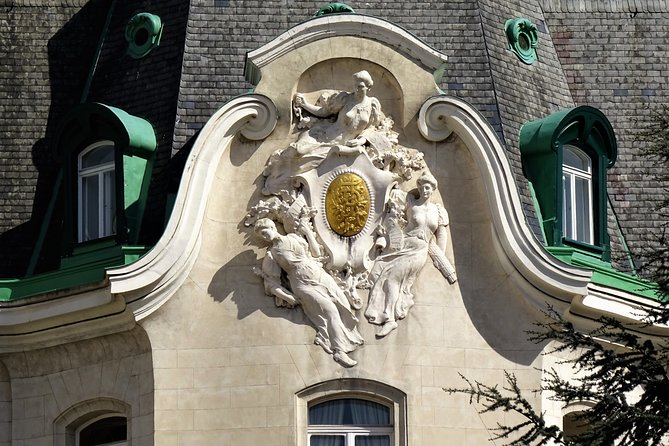
Karlskirche provides one of the tour’s strongest architectural contrasts. The church was built to impress from a distance, and it does exactly that. Its large dome, monumental columns, and broad setting give it the theatrical scale associated with Vienna’s greatest Baroque projects.
The church also introduces the city’s 18th-century high point before the walk shifts forward to the modern age. Your guide explains why the building looks the way it does and how its scale served both religious and political purposes.
You may find the exterior discussion more valuable than a rushed interior visit, since the schedule has several major stops still ahead. The tour is designed to show how Vienna’s public face changed across centuries, not to spend an hour at every building. Take a moment to look back toward the church as you leave. Its grand style makes the later simplicity of Otto Wagner’s station feel even more radical.
More Walking Tours in Vienna
- Vienna: Guided Walking Tour of City Center Highlights
★ 4.7 · 4,989 reviews - Vienna: Vienna Central Cemetery Guided Walking Tour
★ 4.8 · 3,307 reviews - Vienna: Guided Walking Tour of City Highlights & Hidden Gems
★ 4.9 · 2,180 reviews - Vienna: Viennese Underworld Guided Walking Tour
★ 4.7 · 1,865 reviews
Otto Wagner’s Karlsplatz station and the arrival of Art Nouveau
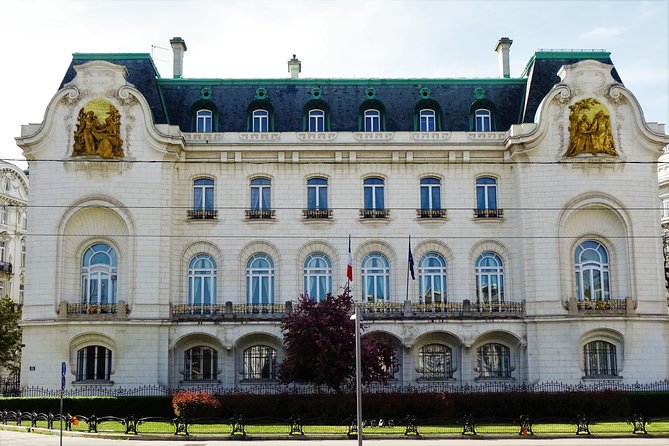
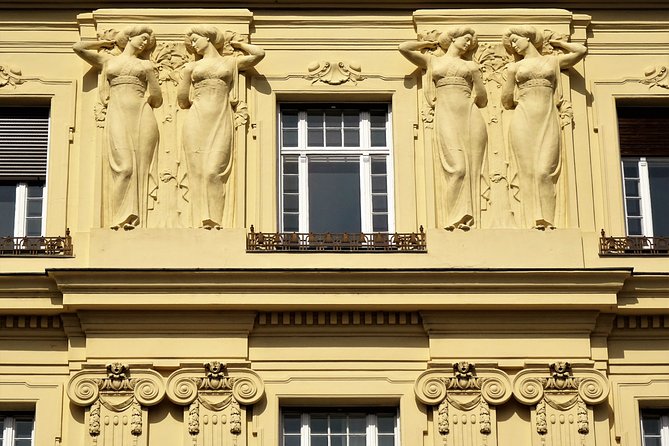
At Karlsplatz, Otto Wagner’s former metro station offers a smaller but very telling piece of Vienna’s Art Nouveau story. It was built for practical transport, yet its pale panels, decorative details, and carefully controlled design give an everyday structure the finish of a work of art.
This is one of the places where the tour makes a clear argument: Art Nouveau was not limited to paintings or luxury interiors. Around 1900, artists and architects were trying to reshape the city itself. Otto Wagner’s work shows how modern transport could still be elegant.
The stop also helps you understand why the Secession artists mattered. They were not merely adding decoration to old Vienna. They were challenging established institutions and asking what modern art and architecture should look like. The route makes that change visible in a few city blocks.
The Musikverein and Vienna’s musical identity
The Wiener Musikverein, home of the Vienna Philharmonic, adds another layer to the walk. Its Great Hall, often called the Golden Hall, is celebrated for its acoustics and is regarded as one of the world’s finest concert halls.
You do not need to attend a concert to appreciate why the building matters. Vienna’s artistic life around 1900 was not only about visual art. Music, theater, psychology, architecture, and painting all developed side by side. The Musikverein represents the city’s musical prestige and gives useful context for Klimt’s Beethoven project at the Secession.
The tour does not promise a concert or an interior performance visit, so treat this as an exterior and cultural stop. If you are especially interested in music, ask how much time the guide plans here before booking.
The Secession Building and Klimt’s Beethoven Frieze
The Secession Building is the clearest architectural statement on the tour. It was built by artists who broke away from Vienna’s established fine-art institution, making the building itself a declaration of independence.
Its design is easy to recognize, especially the famous dome of gilded laurel leaves. The building was not intended as a polite addition to the city. It announced that new art deserved its own place and its own rules.
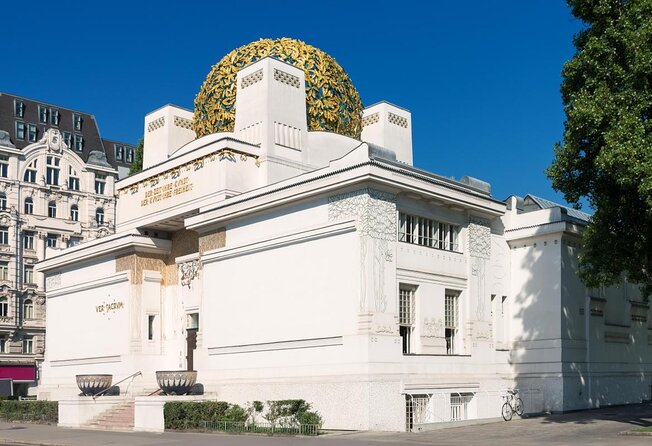
Inside, Klimt’s Beethoven Frieze gives the tour its second major Klimt focus. Klimt created the work for an exhibition celebrating Beethoven. It was made directly onto the walls with light materials and was meant for the exhibition rather than as a permanent architectural feature.
The frieze tells a symbolic story of humanity searching for happiness. It moves through hardship and threatening forces before reaching its famous final image, a kiss to the world. The work is less immediately familiar than The Kiss, but it rewards careful explanation. You can see Klimt moving beyond portraiture into allegory, symbolism, and total-room design.
The planned visit lasts about 30 minutes, so you will need to focus. Admission is again extra. The Secession is not simply a second museum stop added to fill time. It completes the tour’s central idea: Vienna moves from imperial Baroque display to artistic rebellion, with Klimt as one of the key figures in that change.
Naschmarkt, food, and a practical ending
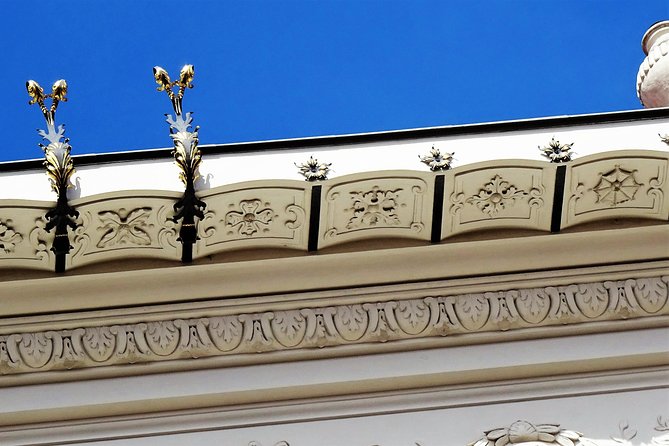
The walk finishes near Naschmarkt, whose present form dates to 1915. Today it combines a food market with international dining, making it a natural place to stop for lunch or a late-afternoon snack.
This ending is useful because it brings the tour back to ordinary city life. After palaces, churches, museums, and concert halls, you reach a place where you can eat, browse, and continue exploring on your own.
Do not assume food is included. Personal expenses are excluded, and the market is best treated as an optional place to buy something after the guided portion. The timing works well for the morning departure, which should leave you near the market around lunchtime, or for the afternoon departure, which may put you there when you want a snack or early meal.
The market is described as being in a transitional stage, so do not expect a frozen-in-time version of old Vienna. It is a changing food and shopping area, and that is part of its current character.
How much walking and public transport to expect
This is not a gentle museum shuttle. You need moderate physical fitness, and you should wear comfortable shoes. One account specifically notes plenty of walking, while another says the guide adjusted successfully to a slower pace for someone in the group.
The experience may include the Vienna metro as part of the route. A positive account praised the guide for explaining the art and city while riding the metro, which suggests that transport is treated as part of the sightseeing rather than dead time. Public transportation is not included, so keep money or a valid ticket available.
The advertised duration is about four hours. The exact pace can vary, especially in a private group. A group eager to discuss Klimt may spend longer at the museums, while a tired group may move faster or cut a stop short. The private format gives you more control than a large scheduled walk, but it does not remove the distance between the Belvedere, central Vienna, and the Secession.
The guide’s style and the private format
The strongest praise goes to the guides’ command of art and Austrian history. Walter is named repeatedly, and Wolfgang is also mentioned positively. Walter is described as especially strong at explaining Klimt, the Belvedere, and the wider historical setting. One account also appreciated an unscheduled beer stop at a local pub, a reminder that the private format can leave room for a small personal touch.
His pace is often described as comfortable and well judged. One group appreciated that he slowed down for a member with limited walking speed. Another found the pace too slow and the delivery too much like a lecture. Both points can be true: a careful pace may be a gift to one group and frustrating to another.
The private arrangement is for only your group, with a maximum of eight people. That is a major advantage if your party wants to ask questions, pause for photographs, or discuss a particular painting. Pickup can be arranged at hotels and vacation rentals in Vienna, the Reichsbrücke pier, Vienna Hauptbahnhof, or Vienna West station. Other meeting points may be arranged.
Service animals are allowed, but pets are not permitted in certain areas visited. The tour is offered in English, and confirmation is sent within 48 hours of booking, subject to availability.
Is $372.47 good value for your group?
The price is $372.47 per group of up to eight people. For a full group, that is a strong value for a private four-hour service with hotel or station pickup and a licensed Austria Guide. Split among eight people, the per-person cost is modest compared with booking separate private guiding.
For one or two people, the calculation changes. You are paying for privacy, route planning, local transport guidance, and focused commentary, but you still pay museum admissions and public transport separately. If your main goal is simply to see The Kiss, a standard museum visit may cost less. If you want the painting explained within Vienna’s Baroque, musical, architectural, and political setting, the private price makes more sense.
The value also depends on how much you enjoy guided interpretation. This is not a silent escort from one photo stop to another. You are paying for stories, connections, and the guide’s point of view. That is a good fit for an art-focused first visit, but less useful if you prefer to explore museums entirely on your own.
Who should book this Vienna art walk?
I would choose this tour if you want to see The Kiss and the Beethoven Frieze in the same half-day, especially if you also want the city between the museums explained. It suits couples, families, and small groups who like asking questions and adjusting the pace.
It is also a smart choice for a short Vienna stay. You get the Belvedere, Schwarzenbergplatz, Karlskirche, Karlsplatz, the Musikverein, the Secession, and Naschmarkt in one organized outing. That is a lot of Vienna in a few hours.
I would hesitate if you dislike long walks, prefer a brisk schedule, or want a completely apolitical guide. I would also set aside extra time if the Belvedere collection or the Secession matters greatly to you, since the planned art visits are focused rather than exhaustive.
Free cancellation is available up to 24 hours before the start time. After that point, the payment is not refunded, and changes are not accepted.
Should you book it?
Book it if you want Klimt with context, not just a famous painting checked off a list. The best feature is the route’s arc from Prince Eugene’s Baroque palace to Vienna’s Art Nouveau rebellion, with The Kiss and the Beethoven Frieze as its two artistic anchors.
Skip it if you want a short, quiet museum outing or if you are uncomfortable with a guide who may share personal views. For an art-minded group that can handle several hours on foot, this is a useful and lively way to understand why Vienna around 1900 mattered so much.
FAQ
How long does the tour last?
The experience lasts approximately four hours.
What time does the tour start?
You can choose a morning departure at 9:30 or an afternoon departure at 14:00.
Are museum admission fees included?
No. Admission to the Upper Belvedere and the Secession Building is not included.
Where can pickup take place?
Pickup is offered at hotels and vacation rentals in Vienna, the Reichsbrücke pier, Vienna Hauptbahnhof, and Vienna West station. Other meeting points may be arranged.
Is public transportation included?
No. Public transportation is excluded from the price.
How many people can join the private tour?
The private activity is for your group only, with up to eight people.
More Walking Tours
- Vienna: World War II Historical Walking Tour
★ 4.8 · 1,772 reviews - Vienna Historic Center Small Group Walking Tour
★ 5.0 · 1,746 reviews - Vienna: 1.5-Hour Underground Walking Tour
★ 4.9 · 1,146 reviews - Vienna: Ghosts and Legends Guided Nighttime Walking Tour
★ 4.4 · 1,088 reviews
Just added around Vienna
- Mobile puzzle rally tour at the Vienna Central Cemetery★ 4.5 · 3 reviews
- RAXI (E-Rickschaw) big private Vienna tour★ 4.5 · 3 reviews
- 8 days European Highlights PRIVATE TOUR from Budapest including Budapest Vienna Prague and Bratislava★ 5.0 · 3 reviews
- Private Transfer from Vienna to Prague with 1 hour Stop in Kutna Hora★ 4.5 · 3 reviews
- Palais Lobkowitz Audio Guide Tour★ 4.0 · 3 reviews
- Private Tour from Vienna to Melk and Dürnstein★ 4.5 · 3 reviews
- Vienna: Designer Fashion Time Capsule Experience★ 5.0 · 3 reviews
- Private day trip from Munich to Eagle’s Nest & Hallstatt★ 4.7 · 3 reviews
Walking Tours, compared.

Guided Walking Tour of City Center Highlights
Read our review →

Guided Walking Tour of City Highlights & Hidden Gems
Read our review →


Vienna Historic Center Small Group Walking Tour
Read our review →
Browse the lists this tour appears in