
Reviewed · WALKING TOURS
Vienna Private Walking Tour including State Opera
Vienna’s grand story fits into one walk. This private tour links Roman Vindobona, Habsburg power, classical music, and modern Austria across the city center, with the State Opera as its headline stop. I like the broad historical sweep, from Roman ruins and medieval walls to the World Wars and the Second Republic. I also like the private format, which gives you a guide for your own group of up to 15 people rather than a large crowd.
The main caution is the opera visit. The description presents it as an included visit, yet booking information says entrance fees are not included, and one account reports that the State Opera stop amounted only to the lobby. Confirm exactly what you will enter and what you must pay before booking, especially if the opera is your main reason for choosing this tour.
In This Review
- Key points to know before you book
- A three-hour introduction to Vienna’s center
- Starting at the State Opera and Mozart Monument
- The Hofburg and the power of the Habsburgs
- Graben, Peterskirche, and the road to Stephansdom
- What the history section does well
- How much value do you get for $323?
- Pace, footwear, and practical comfort
- Who will get the most from this walk?
- Should you book this Vienna walking tour?
- FAQ
- Where does the tour meet?
- How long does the tour last?
- Is the tour private?
- Which languages are available?
- Is the State Opera entrance included?
- What landmarks are included?
- What should I bring?
- Can I cancel the booking?
Key points to know before you book
- The route begins at Stephansplatz 8A, then moves through Vienna’s imperial center toward the State Opera and Hofburg landmarks.
- The State Opera details need clarification, since entrance fees are excluded and the visit may be limited to the lobby unless an extra ticket is arranged.
- The history runs from Roman Vindobona to the Austrian Second Republic, giving you a useful first look at Vienna’s long political story.
- The tour is private for up to 15 people, so the $323 group price can make sense for a family or small party, but it is expensive for one or two people.
- Classical music is a major theme, with Mozart, Haydn, Beethoven, Schubert, the Strauss family, Brahms, and Mahler tied into Vienna’s streets and institutions.
- Comfortable shoes matter, and the tour is not suitable for people with mobility impairments.
A three-hour introduction to Vienna’s center
This is a history-heavy walking tour with music and architecture woven through it. You are not simply checking off churches and palace facades. The guide is meant to explain how Vienna changed from a Roman settlement into the seat of the Habsburgs, then into the capital of an Austrian republic shaped by war and political upheaval.
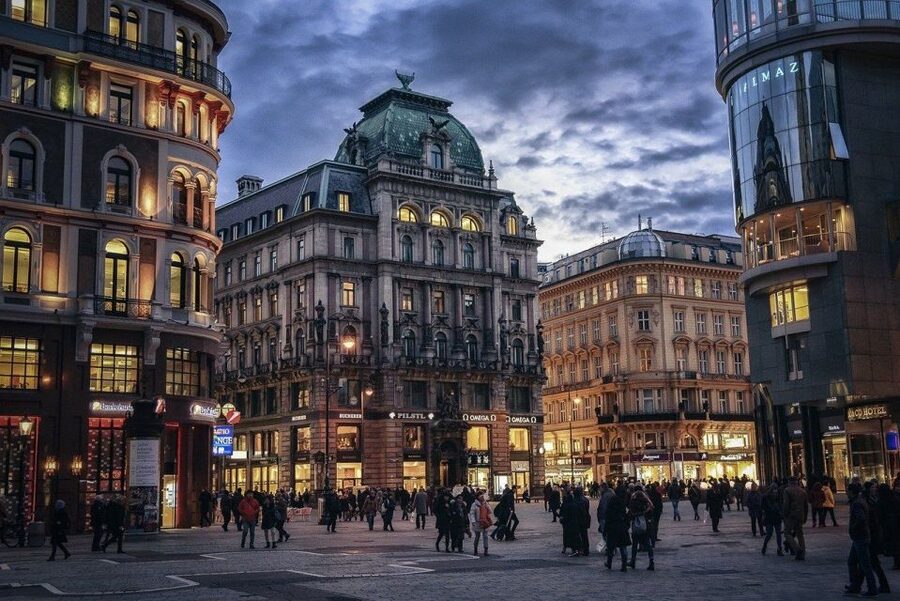
The route covers a lot in three hours. That is useful if Vienna is new to you and you want a clear framework before exploring on your own. It can also feel brisk, since the stops include the State Opera, Mozart Monument, Hofburg, Michaelerkirche, Roman remains, Graben, Peterskirche, and Stephansdom.
The tour is offered in English or German. Since it is a private group, you can ask for explanations at your own pace, though the practical value depends heavily on the individual guide. One German-language booking account praised the guide’s competence and found the three hours engaging. Another French-language account described the guide as pleasant and appreciated having time to look around.
That contrast matters. The strongest positive feedback focuses on the guide’s delivery, especially the ability to make three hours pass quickly and leave time for observation. The overall score is 3.2 out of 5 from seven ratings, so I would treat the guide quality as less predictable than the attractive route suggests.
More Private Tours in Vienna
- Vienna: Private Walking Tour with a Local Guide
★ 4.6 · 1,420 reviews - Vienna: Private Walking Tour with a Guide
★ 4.7 · 962 reviews - Vienna: Wine Tasting Experience in a Private Wine Cellar
★ 4.8 · 413 reviews
Starting at the State Opera and Mozart Monument
The tour begins at Stephansplatz 8A, though the supplied description also frames the State Opera as the opening point. Confirm the exact meeting instructions with the operator, since these two locations are not the same part of the center.
The Vienna State Opera is a fitting place to discuss the city’s musical identity. The building dates to the 1860s, when it was known as the Vienna Court Opera. Its name changed in 1920 as the early Austrian Republic took shape, a small detail that neatly connects music with the end of Habsburg rule.
The opera has hosted major conductors such as Gustav Mahler, Herbert von Karajan, and Claudio Abbado. Its program has included works such as La Traviata, La Clemenza di Tito, and Verdi’s Don Carlo. You will also hear the names of Mozart, Josef Haydn, Ludwig van Beethoven, Franz Schubert, Johann Strauss the elder and younger, Johannes Brahms, and Gustav Mahler as the tour places Vienna’s music in its wider setting.
The Mozart Monument adds a visual stop to that musical story. It is not the same as visiting a composer museum or attending a performance, but it helps put Vienna’s public memory on the street. You can expect the guide to use the monument and opera house as entry points into the city’s artistic life.
Here is the important limitation: the wording about visiting the opera is not fully clear. One booking account says the State Opera visit was only a look at the lobby. Another says a proper opera tour had to be booked and paid for separately. Since entrance fees are specifically excluded, do not assume this package includes access to backstage areas, auditorium spaces, or a formal guided tour of the building.
The Hofburg and the power of the Habsburgs
From the opera area, the route takes in the Hofburg and the Art History Museum facades. Even without entering either building, the exteriors give the guide plenty to explain about the Habsburg monarchy and its long reach across Central Europe.
The Hofburg served for centuries as the Habsburg imperial residence. It is one of the best places in Vienna to understand how government, ceremony, religion, and royal image were tied together. The Art History Museum adds the fine-arts side of that story, pointing toward Vienna’s 19th and 20th-century artistic life.
You will hear about the Holy Roman Empire and the later Austro-Hungarian Empire. Those names can blur together in a textbook, so a walking guide can help connect them to actual buildings and streets. The value here is not an exhaustive political lecture. It is a readable outline of who held power, how the imperial center worked, and why Vienna became such an important European capital.
The tour also reaches the Michaelerplatz area and passes through the Michaeler Tor gate. The Church of St. Michael, or Michaelerkirche, served for years as the official church of the emperors. That makes it more than a pretty Baroque church facade. It is a reminder that Habsburg authority rested on public ritual as much as on administration and armies.
The square also contains Roman ruins, medieval wall remains, and remnants of the old Burg Theatre. These fragments are especially useful because they reveal several layers of Vienna in one place. You can look at the imperial entrance above ground while seeing evidence of a much older city beneath your feet.
Graben, Peterskirche, and the road to Stephansdom
Graben is one of central Vienna’s best-known streets, and the tour uses it to move from imperial history toward the cathedral quarter. The route notes its Roman origins and the story of Richard the Lionheart entering the city by this way.
Graben today is polished and urban, but its name and position recall an earlier defensive ditch. That change from Roman edge to medieval route to modern shopping street is typical of Vienna. You get a sense of how the center kept being rebuilt without losing every trace of its earlier form.
Peterskirche provides another church stop. The church has been associated with this location since the fourth century, although the building you see today belongs to a much later architectural period. The guide can help you separate the age of the site from the age of the present structure, an important distinction in a city where ancient foundations often sit beneath newer facades.
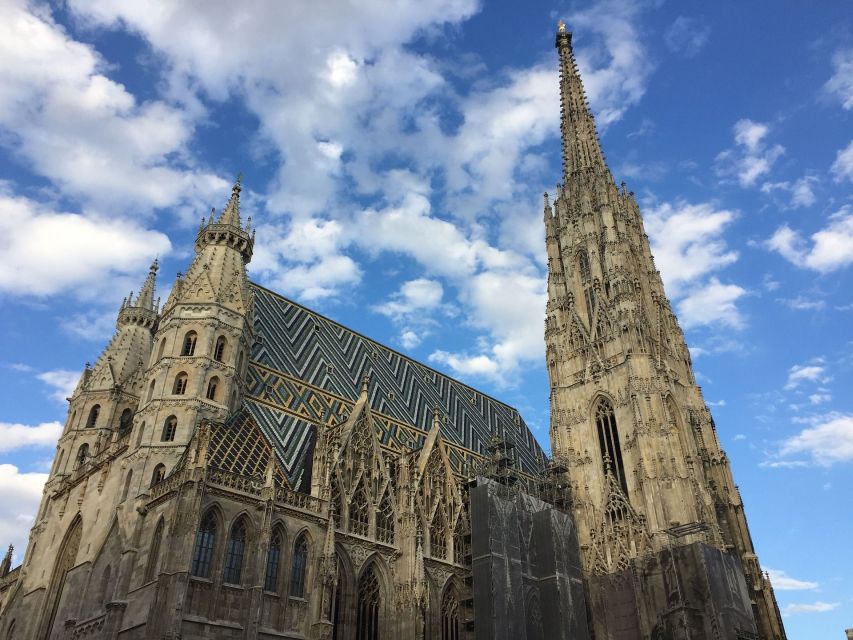
The route ends at Stephansplatz and Stephansdom, Vienna’s cathedral. The cathedral is a Roman-Gothic masterpiece and one of the tallest churches in the world. Even if you only view it from the square, its scale gives the walking tour a strong finish.
Stephansdom also helps bring the tour back to its starting area. You see the cathedral not as an isolated photo stop, but as part of the city’s religious, political, and commercial core. If you want to enter the cathedral or climb any tower, ask the guide what is included. The supplied details do not promise interior admission or tower access.
More Walking Tours in Vienna
- Vienna: Guided Walking Tour of City Center Highlights
★ 4.7 · 4,989 reviews - Vienna: Vienna Central Cemetery Guided Walking Tour
★ 4.8 · 3,307 reviews - Vienna: Guided Walking Tour of City Highlights & Hidden Gems
★ 4.9 · 2,180 reviews - Vienna: Viennese Underworld Guided Walking Tour
★ 4.7 · 1,865 reviews
What the history section does well
I like the tour’s decision to connect several eras instead of treating Vienna as one frozen imperial postcard. You get Roman Vindobona, medieval defenses, Habsburg rule, the Holy Roman Empire, the Austro-Hungarian Empire, two World Wars, and the birth of the Second Republic.
That range gives you context for later sightseeing. After the walk, the Hofburg is easier to understand as a former center of dynastic power. The opera is easier to place within the transition from court culture to the republic. The Jewish quarter and war-era subjects, if included in the guide’s chosen route, can also be understood as part of Vienna’s 20th-century story rather than as disconnected memorial stops.
Still, three hours cannot give equal attention to every era. You should expect an overview, not a specialist history seminar. If you already know Vienna well, you may want a tour focused on one subject, such as the Habsburgs, Secession art, Jewish Vienna, or classical music.
The handling of difficult history also deserves care. A serious complaint about a guide named Franziska Pfisker describes offensive political remarks and insensitive language about the murder of Jews during the Holocaust. I cannot establish from the supplied information whether this reflects a wider pattern, but it is a serious concern and should not be brushed aside. The subject demands precise language: people were systematically murdered, not simply lost their lives.
Because the tour is private, you have more control than on a large group outing. If the discussion becomes political or uncomfortable, you can redirect it toward architecture, music, or documented history. You may also wish to contact Travmonde OÜ in advance and request a guide who will handle wartime and Holocaust history with appropriate care.
How much value do you get for $323?
The price is $323 per group of up to 15 people. That is not a per-person rate. For a full group, the cost works out to about $22 per person, before any separate entrance fees. For two people, it is about $162 each, which is a high price for a three-hour walk. For a family or group of friends, the calculation looks much better.
The private format is the main reason to consider the cost. You are paying for dedicated guiding rather than a standard shared tour, and you can ask questions without competing with a crowd. A private group can also make sense if your party has a particular interest in music, the Habsburgs, or Vienna’s political history.
The value drops sharply if you expect a full State Opera tour and discover that only the lobby is included. Since entrance fees are excluded, add the cost of any opera access before comparing this with other Vienna walks. The title and description create a stronger expectation than the included-fee wording supports.
I would book it for a group of six to 15 people that wants one broad orientation walk. I would hesitate to book it for a couple unless the private guide and opera access are confirmed in writing.
Pace, footwear, and practical comfort
This is a walking tour through the historic center, so wear comfortable shoes. The route includes several streets and public squares, and the experience is not suitable for people with mobility impairments.
The stated duration is three hours. That is long enough to cover the major landmarks but short enough to fit around another museum visit or an evening performance. You should allow extra time if the guide stops for questions or if your group wants photographs.
The activity is offered with a live guide in English or German. A private group can be especially useful if members have different levels of background knowledge. You can ask for a slower explanation at the Hofburg or spend more time on the music story near the opera.
The tour offers free cancellation up to 24 hours before the start time and allows you to reserve now and pay later. Those terms help if your Vienna plans may change, but they do not solve the key uncertainty about opera admission. Clarify that first.
Who will get the most from this walk?
You will probably like this tour if you are visiting Vienna for the first time and want a guide to tie the center together. It suits people who enjoy architecture, imperial politics, classical music, and a broad historical narrative more than those seeking a single museum or a long interior visit.
Families and small groups can get good value from the fixed group price. The private arrangement also lets you ask basic questions without feeling rushed by a large party. If your group includes serious music fans, the opera history may be a useful introduction, but it does not replace attending a performance or arranging a proper behind-the-scenes visit.
You should think twice if you have limited walking ability, want extensive time inside the State Opera, or prefer a tightly focused subject. You should also be careful if respectful treatment of modern political and wartime history is a major concern. Contact the provider before booking and ask who will guide your group and exactly how the opera portion works.
Should you book this Vienna walking tour?
Book it if you want a private, three-hour overview of Vienna’s center and you are traveling with enough people to make $323 reasonable. The route is strong: Stephansdom, Graben, Peterskirche, the Hofburg, Michaelerkirche, Roman remains, Mozart, and the State Opera create a useful first look at the city.
Do not book it on the assumption that a full State Opera visit is automatically included. The available information points to a possible lobby-only stop, with additional opera admission at extra cost. Confirm the details before paying.
The best reason to choose this experience is its range and private format. The biggest risks are inconsistent guiding, unclear opera access, and the need to handle modern history with care. For a group that confirms those points in advance, it can be a practical introduction to Vienna. For a couple seeking a guaranteed opera interior tour, a more specific opera visit may offer better value.
FAQ
Where does the tour meet?
The meeting point is Stephansplatz 8A, 1010 Vienna, Austria. The description also refers to the State Opera as the starting area, so confirm the precise meeting instructions before the tour.
How long does the tour last?
The walking tour lasts three hours.
Is the tour private?
Yes. It is offered as a private group experience for up to 15 people.
Which languages are available?
A live guide is available in English or German.
Is the State Opera entrance included?
The information is unclear. The activity includes a visit to the State Opera, but entrance fees are not included. One booking account describes the visit as limited to the lobby, while another says a separate opera tour and payment were needed. Confirm this directly before booking.
What landmarks are included?
The route includes the State Opera, Mozart Monument, Art History Museum facades, Hofburg, Michaeler Tor, Michaelerkirche, Roman ruins, medieval wall remains, old Burg Theatre remains, Graben, Peterskirche, Stephansplatz, and Stephansdom.
What should I bring?
Bring comfortable shoes for the three-hour walk.
Can I cancel the booking?
You can cancel up to 24 hours in advance for a full refund. The experience also offers reserve-now, pay-later booking.
More Walking Tours
- Vienna: World War II Historical Walking Tour
★ 4.8 · 1,772 reviews - Vienna Historic Center Small Group Walking Tour
★ 5.0 · 1,746 reviews - Vienna: 1.5-Hour Underground Walking Tour
★ 4.9 · 1,146 reviews - Vienna: Ghosts and Legends Guided Nighttime Walking Tour
★ 4.4 · 1,088 reviews
Just added around Vienna
- Mobile puzzle rally tour at the Vienna Central Cemetery★ 4.5 · 3 reviews
- RAXI (E-Rickschaw) big private Vienna tour★ 4.5 · 3 reviews
- 8 days European Highlights PRIVATE TOUR from Budapest including Budapest Vienna Prague and Bratislava★ 5.0 · 3 reviews
- Private Transfer from Vienna to Prague with 1 hour Stop in Kutna Hora★ 4.5 · 3 reviews
- Palais Lobkowitz Audio Guide Tour★ 4.0 · 3 reviews
- Private Tour from Vienna to Melk and Dürnstein★ 4.5 · 3 reviews
- Vienna: Designer Fashion Time Capsule Experience★ 5.0 · 3 reviews
- Private day trip from Munich to Eagle’s Nest & Hallstatt★ 4.7 · 3 reviews
Walking Tours, compared.

Guided Walking Tour of City Center Highlights
Read our review →

Guided Walking Tour of City Highlights & Hidden Gems
Read our review →


Vienna Historic Center Small Group Walking Tour
Read our review →
Browse the lists this tour appears in