
Reviewed · WALKING TOURS
Private walking tour through the old town of Salzburg
Salzburg packs centuries into a walkable center. This private two-hour tour gives you a lively introduction to the city, moving from Mirabell Palace across the Salzach River and into the old town. I especially like the mix of Mozart sites and Sound of Music locations, plus the chance to ask your own questions instead of following a fixed group script. The tour also covers major Baroque sights, medieval lanes, and everyday life before electricity in a compact route.
The price is $89.01 per person, which is fair for a private experience if you are traveling with family or friends and want a guide focused only on your group. I also like the steady pace and the guide’s willingness to pause, both useful if you have mobility concerns. The main caution is that the guide’s humor and personal opinions may not suit everyone, as one strongly negative review described inappropriate jokes and an unprofessional tone.
In This Review
- What makes this Salzburg walk worth considering
- Starting at Mirabell Palace and its garden
- Mozart’s Salzburg begins at his residence
- Crossing the Salzach River into Getreidegasse
- From Grünmarkt to the Baroque Kollegienkirche
- Town Hall, Alter Markt, and Mozart’s favorite cafe
- Residenzplatz and the former princely city
- Mozartplatz and Salzburg Cathedral
- Ending at Kapitelplatz beneath Hohensalzburg Fortress
- What the private format adds at $89.01
- Guide style, humor, and the one serious caution
- Who should book this Salzburg walking tour?
- Should you book it?
- FAQ
- Where does the tour begin?
- Where does the tour end?
- How long is the walking tour?
- Is this a private tour?
- How much does the tour cost?
- Which Mozart locations are included?
- Does the tour include Sound of Music locations?
- Is the tour suitable for people with mobility concerns?
- Can I cancel for a full refund?
What makes this Salzburg walk worth considering
- Mirabell Palace begins the story with one of Salzburg’s most graceful Baroque settings and a familiar Sound of Music connection.
- Mozart appears twice, first at the house where he lived and later at the Getreidegasse building where he was born.
- The route crosses from modern Salzburg into the old town through the Salzach River area and medieval passages.
- Getreidegasse mixes history with daily life, including guild signs, shops, arcades, and the nearby Grünmarkt.
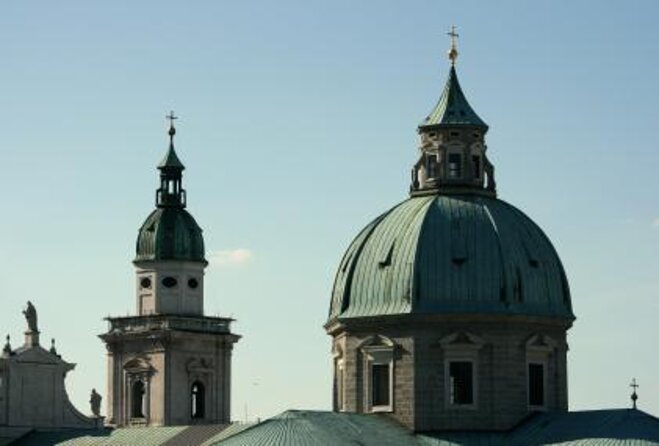
- The finale brings the best fortress view, with Hohensalzburg Fortress rising above Kapitelplatz and St. Peter’s Abbey.
- Private touring keeps the walk flexible, with only your group taking part and group discounts available.
Starting at Mirabell Palace and its garden
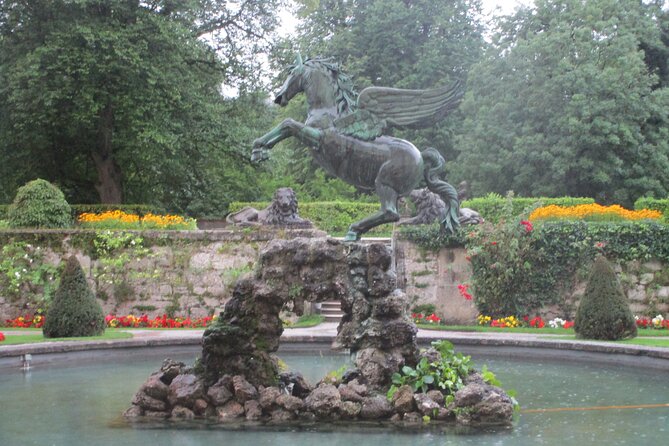
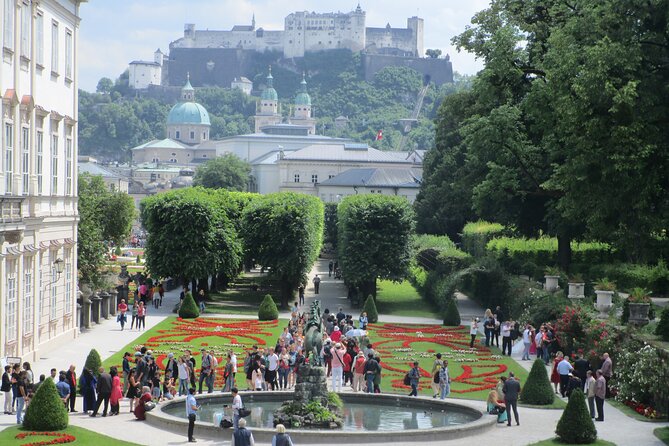
Your meeting point is Bellini’s Cafe & Bar at Mirabellplatz 4. From there, the walk begins in the garden of Mirabell Palace, a strong opening because Salzburg immediately gives you architecture, formal gardens, and mountain-city scenery in one place.
I like starting here rather than plunging straight into the busiest old-town lanes. The garden gives you room to get oriented, and the guide can explain how Salzburg’s prince-archbishops shaped the city. The palace and garden also connect to The Sound of Music, so film fans get an early reference without needing a separate movie-themed excursion.
The garden is not the only reason this first stop works. It sets up one of the tour’s recurring themes: Salzburg’s ability to place intimate spaces beside grand architecture. Within a short distance, you move from clipped garden design to river views, narrow passages, churches, palaces, and a fortress on the hill.
You should expect this opening stop to be a look and listen rather than a palace interior visit. The tour description centers on the garden, so you should not book it expecting a full guided tour of Mirabell Palace rooms.
More Private Tours in Salzburg
- Original Sound of Music Private Tour Salzburg
★ 4.5 · 310 reviews - Salzburg Old Town Highlights Private Walking Tour
★ 4.5 · 78 reviews - Private Full-Day Tour of Hallstatt and Salzkammergut from Salzburg with Options
★ 5.0 · 77 reviews
Mozart’s Salzburg begins at his residence
The next stop is Mozart’s house. The route includes a look at the building associated with Mozart’s life in Salzburg, before taking you toward the old town.
That distinction matters. The later stop at Getreidegasse is the house where Mozart was born, while this earlier location is described as Mozart’s house. You get two separate points in the composer’s story rather than one quick photo stop.
The guide also connects Mozart to the city’s wider culture. In Salzburg, his name appears on squares, cafes, chocolates, concert advertising, and souvenir shops. This walk helps place those modern reminders against the city where he actually lived and worked.
If you want extensive detail about Mozart’s music, family, and career, two hours cannot cover everything. I see this part as a useful orientation. You learn why Mozart is so present in Salzburg, then continue through the city instead of spending the whole visit in a single museum.
Crossing the Salzach River into Getreidegasse
The route reaches the old town via the Salzach River. This transition is one of the most satisfying parts of the walk because the city changes character as you cross toward the historic center.
Medieval house passages lead into Getreidegasse, one of Salzburg’s most recognizable streets. Traditional guild signs hang above shops, giving the lane a distinctive look even where modern retail has taken over. I like this combination because it keeps the street from becoming a frozen monument. You see a working shopping lane that still carries visual clues from older trades.
Getreidegasse can be busy, and the narrow passages may make it harder to hear if the area is crowded. A private tour helps here because you can ask the guide to repeat a point or pause in a quieter spot. You are not trying to absorb a long lecture while walking shoulder to shoulder with a large group.
The major Mozart stop comes here: the house where he was born. The guide’s role is especially useful at this point. Without context, the yellow building can become another quick picture. With a guide, you can connect the address to Mozart’s place in Salzburg’s civic identity and understand why this single building receives so much attention.
From Grünmarkt to the Baroque Kollegienkirche
Near Mozart’s birthplace, an arcaded courtyard leads to the Grünmarkt. This short passage is exactly the kind of urban detail that makes a walking tour more useful than a sightseeing bus. You get a sense of how Salzburg’s old center is arranged, with courtyards, covered walkways, shops, and public spaces linked together.
The route then reaches the Kollegienkirche, described as the first church built in the Austrian Baroque era. Its importance is not only religious. It shows how the city’s rulers used architecture to express power, order, and Catholic identity.
I appreciate that the tour includes the university church rather than only the headline sights. Salzburg’s Cathedral and fortress are obvious draws, but the Kollegienkirche gives you another look at the city’s grand architectural style. The word bombastic fits the exterior and interior ambition, though the tour does not promise an extended indoor visit.
You should also keep the timing in mind. The entire walk lasts about two hours, and this is one stop among many. The guide will likely explain the church’s place in Salzburg’s story, but you should not expect a specialist art lecture at every building.
More Walking Tours in Salzburg
- Salzburg 2.5-Hour Walking Tour: Mozart, Old Town & More
★ 4.2 · 987 reviews - Salzburg: Old Town, Mozart, & Mirabell Gardens Walking Tour
★ 4.8 · 461 reviews - Salzburg Oldtown: Sightseeing Walking Tour with Licensed Local Guide
★ 5.0 · 392 reviews - Salzburg Old Town Walking Tour, Mozart, Mirabell Gardens
★ 4.5 · 201 reviews
Town Hall, Alter Markt, and Mozart’s favorite cafe
After the church, the walk passes the town hall and continues to Alter Markt. This square brings together several very Salzburg details: Mozart’s favorite cafe, shops selling Mozart balls, and luxury stores.
This is a good place to see how the old town balances local tradition with tourism. Mozart balls are a familiar Salzburg specialty, while the elegant shops show the city’s long connection with wealth and status. The square is not presented as a formal tasting stop, so you should think of it as a place to look, listen, and perhaps note where you might return later.
I like this portion because it adds ordinary city life to the grand historical route. You hear about cafes, shopping, and local customs rather than moving only from one palace to another. The guide also discusses daily life before computers, mobile phones, and electricity, which can make the old buildings feel less like scenery and more like places where people actually lived.
The town hall stop is brief in the stated route, but it helps explain the civic side of Salzburg. After palaces and churches, you get a reminder that this was also a governed city with markets, offices, and residents going about their business.
Residenzplatz and the former princely city
The so-called princely town begins near Alter Markt. At Residenzplatz, you see the old and new Residenz, along with the large Baroque fountain in the center.
This is where Salzburg’s political and religious power becomes most visible. The Residenz buildings represent the world of the prince-archbishops, who ruled the city and surrounding territory for centuries. The fountain adds scale to the square and helps you understand why Salzburg’s center can feel grand even when you are walking through relatively small streets.
I find this stop valuable because it gives the city a clear visual hierarchy. The old town is not simply a collection of pretty buildings. Its squares, palaces, churches, and fortress reflect the authority of rulers who wanted their city to look impressive.
The open square may feel exposed in poor weather, and there is little shade information provided. Bring practical walking gear, especially in hot sun or rain. The tour is outdoors for most of its duration, and the route continues through several public spaces.
Mozartplatz and Salzburg Cathedral
A short detour brings you to Mozartplatz, followed by the monumental Salzburg Cathedral. The square gives you another Mozart reference, while the Cathedral provides one of the tour’s biggest architectural moments.
The Cathedral is described as the largest and oldest Baroque church north of the Alps. Even if you are not focused on church architecture, the scale is hard to miss. The tour emphasizes the exterior view, so you should confirm separately if entering the church or visiting related museum spaces is important to you.
I like the sequence here. Mozartplatz is relatively intimate and personal, then the Cathedral shifts the mood toward ceremony and power. Salzburg repeatedly does this on a small scale: a quiet square opens into a huge façade, and a narrow passage releases you into a formal public space.
The guide can also help you read the Cathedral as part of the wider city. Instead of seeing it as an isolated church, you begin to understand its relationship to Residenzplatz, St. Peter’s, and Hohensalzburg Fortress.
Ending at Kapitelplatz beneath Hohensalzburg Fortress
The walk ends at Kapitelplatz, next to the Cathedral and about 150 meters from Getreidegasse. This is a practical finishing point because you are already in the heart of Salzburg and can continue exploring on foot afterward.
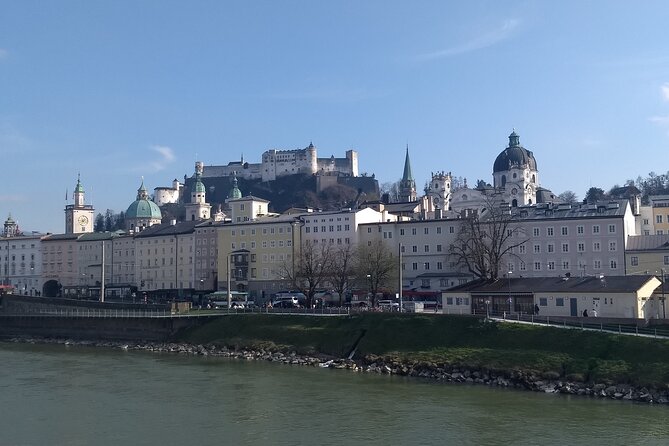
Kapitelplatz offers views of St. Peter’s Abbey, identified as the oldest monastery in the German-speaking world and the cradle of Christianity in Austria. The square’s strongest visual moment is the view up to Hohensalzburg Fortress, around 100 meters above the city.
I think this is the right ending. The fortress is Salzburg’s symbol, and seeing it from below gives you an immediate sense of the city’s defensive and political history. The view also leaves you with a clear next choice: continue around the Cathedral area, explore St. Peter’s, or visit the fortress on another part of your day.
The tour does not include a fortress visit or admission. That is not a flaw for a short orientation walk, but you should plan extra time if you want to go up and see the interior.
What the private format adds at $89.01
At $89.01 per person, the price makes the most sense for a couple, family, or group of friends who value personal attention. You are paying for a licensed guide and a route through many of Salzburg’s major sights, not for admission tickets or a long museum visit.
The private format lets you ask about Mozart, film locations, architecture, local customs, or practical sightseeing plans as they arise. It also allows some flexibility. One guest specifically praised the guide for stopping when requested, while another noted that the pace was steady and manageable for someone with mobility issues.
Group discounts may improve the value for larger parties. Since only your group participates, you avoid the uncertainty of a large public tour. You can also use the two hours to get your bearings before exploring independently.
The limitation is simple: two hours is an introduction, not a full study of Salzburg. If you want detailed access to interiors, extensive music history, or a long list of film locations, you will need more time and possibly different tours.
Guide style, humor, and the one serious caution
Most of the feedback praises Florian Fink von Finkenheim for his historical knowledge, preparation, friendliness, humor, and enthusiasm. The strongest pattern is clear: he gives first-time visitors a useful introduction and adds extra details beyond the basic route.
Several comments specifically praise the way he combines Salzburg history with Sound of Music references. One person requested more film information and received it, which suggests you should speak up about your interests during this private walk. Another praised his local history and humor, while others valued his flexibility when they wanted to pause.
There is one important caution. A one-star account described suggestive jokes, inappropriate comments, and an unprofessional manner. The guide replied that the group could have raised concerns during the private tour, but that response does not remove the concern. If a guide’s tone feels wrong to you, say so clearly during the walk or end the experience if necessary.
The overall score is 4.7 from 12 reviews, with 92 percent recommending the experience. That is a strong result, but the small number of reviews means you should still consider your comfort with the guide’s humor and personal style.
Who should book this Salzburg walking tour?
I would choose this tour if you are visiting Salzburg for the first time and want the essential old-town sights explained in a short period. It suits you especially well if Mozart, The Sound of Music, Baroque architecture, and city history all interest you.
It also works for families and private groups that want to set their own rhythm. The reported steady pace and willingness to stop may help if you have mild mobility concerns, although the tour still involves walking through streets, passages, squares, and river-side areas.
You may prefer a different experience if you want a formal museum tour, a fully dedicated film-location tour, or a guide whose style is strictly serious. The route is broad and efficient, not designed for detailed study at every stop.
Booking includes mobile ticketing and confirmation at the time of booking. Service animals are allowed, and the meeting point is near public transportation. Most people can participate, according to the tour information. Free cancellation is available up to 24 hours before the start time, but cancellations or changes made later are not refunded or accepted.
Should you book it?
Book this private walk if you want a friendly, efficient introduction to Salzburg with Mozart, film history, medieval lanes, Baroque squares, and a fortress view all in one route. The best value comes when two or more people can share the private experience and use the guide for questions and local context.
I would skip it if you want extensive interior visits or a long, specialized music tour. For most first-time visitors, though, the route covers the right sights in the right order and ends in a useful central location. Just keep the one complaint about humor in mind, and make your expectations clear at the start.
FAQ
Where does the tour begin?
It begins at Bellini’s Cafe & Bar, Mirabellplatz 4, 5020 Salzburg, Austria.
Where does the tour end?
It ends at Kapitelplatz, next to Salzburg Cathedral. Kapitelplatz is about 150 meters from Getreidegasse.
How long is the walking tour?
The tour lasts approximately two hours.
Is this a private tour?
Yes. Only your group participates in the activity.
How much does the tour cost?
The listed price is $89.01 per person. Group discounts are available.
Which Mozart locations are included?
The route includes a look at Mozart’s house and a stop at the house where Mozart was born in Getreidegasse.
Does the tour include Sound of Music locations?
Yes. The experience includes several filming locations connected with The Sound of Music.
Is the tour suitable for people with mobility concerns?
The walk has been described as moving at a steady pace, and the guide may accommodate requests to stop. Most people can participate, according to the tour information.
Can I cancel for a full refund?
Yes. You can cancel at least 24 hours before the start time for a full refund. Cancellations or changes made less than 24 hours before the experience are not accepted.
More Walking Tours
- Salzburg Private Walking Tour
★ 4.6 · 48 reviews - Private Walking Tour of Salzburg
★ 5.0 · 42 reviews - Salzburg Old Town, Fortress, Cathedral Private Walking Tour
★ 4.5 · 41 reviews - Salzburg Introduction Walking Tour
★ 5.0 · 31 reviews
Just added around Salzburg
- Salzburg & “The Sound of Music” Full Day Driver-Guided Tour★ 5.0 · 3 reviews
- MONDSEE: The Strudelgirl – bake your Apple Strudel Dream★ 5.0 · 3 reviews
- Zell am See Alpine Village Private Day Trip from Salzburg★ 5.0 · 3 reviews
- Salzburg “Sound of Music” Private Driver-Guided Tour★ 5.0 · 3 reviews
- Private Transfer from Salzburg to Vienna: Door-to-door, English-speaking driver★ 4.5 · 3 reviews
- From Vienna: Austrian Lakes and Salzburg Private Tour★ 5.0 · 3 reviews
- Salzburg für Salzburger★ 5.0 · 3 reviews
- Private Tour: Discover Salzburg and the Stunning Lake District★ 5.0 · 3 reviews
Walking Tours, compared.

Guided Walking Tour of City Center Highlights
Read our review →

Guided Walking Tour of City Highlights & Hidden Gems
Read our review →


Vienna Historic Center Small Group Walking Tour
Read our review →
Browse the lists this tour appears in