
Reviewed · CONCERTS
Vienna: Romantic Classics Piano, Violin, and Cello Concert
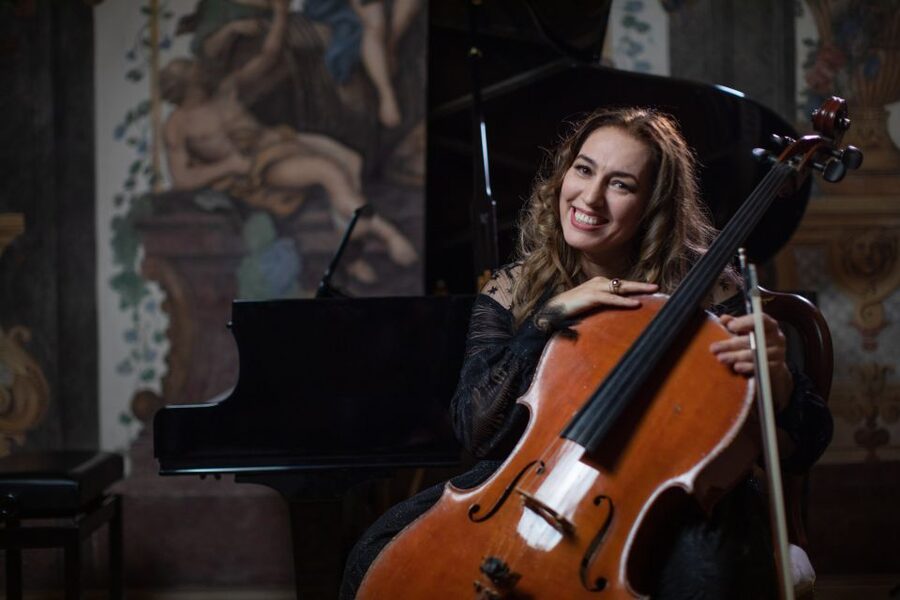
Vienna’s grandest music can fit in a small room. This 90-minute Romantic Classics concert brings piano, violin, and cello works into the Sala Terrena, a historic space with expressive frescoes and close-up views of the musicians. I like the easy location, just 150 meters from St. Stephen’s Cathedral, and the program’s broad sweep from Haydn and Mozart to Chopin, Liszt, and Schubert. The main consideration is that refreshments are not included, and buying them during the break requires cash.
The intimate setting helps the music feel personal rather than grand and distant. I also like that you can choose among student, back-row, and seats closer to the performers, though the small venue means the seating choice may matter more than usual.
In This Review
- Five things to know before booking
- A small Vienna room with a serious musical past
- What the 90-minute program actually gives you
- Liszt, Chopin, and the most romantic part of the evening
- Bach, Paganini, and a change in texture
- Schubert closes with chamber music
- The sound and the close-up experience
- Names worth knowing before the performance
- Price, seating, and what is included
- Timing, arrival, and access
- Who will enjoy this concert most
- Should you book the Romantic Classics concert?
- FAQ
- How long does the concert last?
- Where is the concert held?
- How far is the venue from St. Stephen’s Cathedral?
- How early should I arrive?
- What languages are available at the venue?
- Is the concert wheelchair accessible?
- What types of tickets are available?
- Is a cloakroom included?
- Are refreshments included?
- Can I cancel the booking?
Five things to know before booking
- The Sala Terrena is only 150 meters from St. Stephen’s Cathedral, making this an easy evening addition to a central Vienna day.
- The 90-minute program covers many musical moods, from Beethoven’s quiet Moonlight Sonata to Paganini’s fiery Caprice 13.
- Close seating brings you near the performers, while back-row tickets may offer a better price.
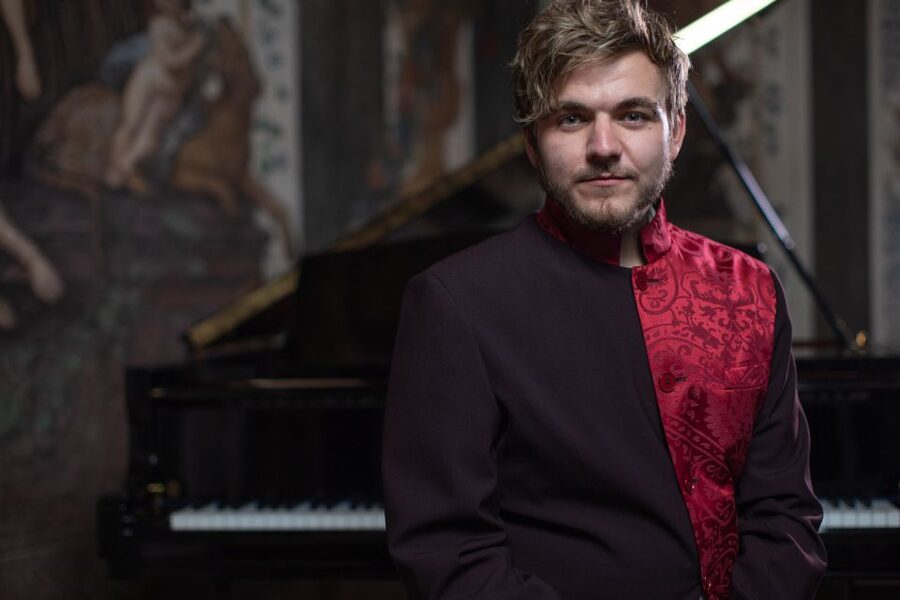
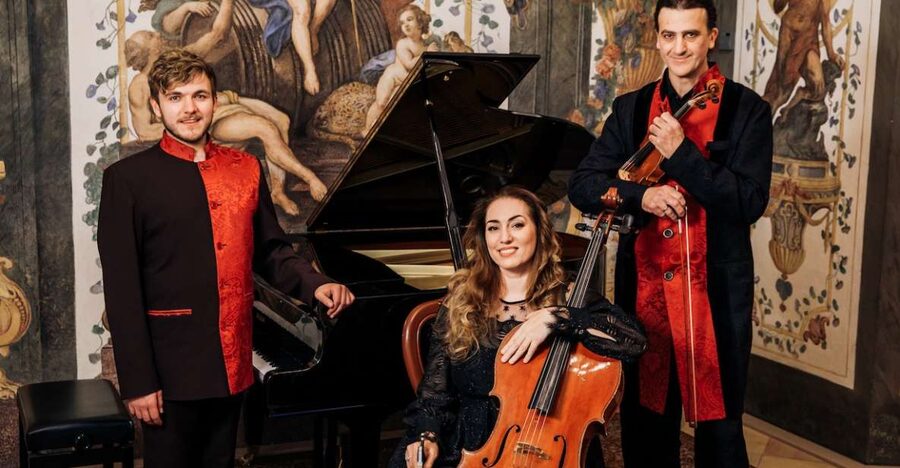
- The musicians include Dushan Sretovic, Claudio Bentes, and Teodora Miteva, all presented as accomplished performers with international experience.
- The sound is a major strength, with clear acoustics praised even in the relatively small room.
- Arrive 15 minutes early, and remember that break-time refreshments, if you want them, are bought separately with cash.
A small Vienna room with a serious musical past
The concert takes place in the Sala Terrena, reached through the gate at Deutschordenskirche. Look for the poster stand connected with concerts at Mozarthaus. The venue is close enough to St. Stephen’s Cathedral that you can walk there quickly after sightseeing, dinner, or an evening around the old center.
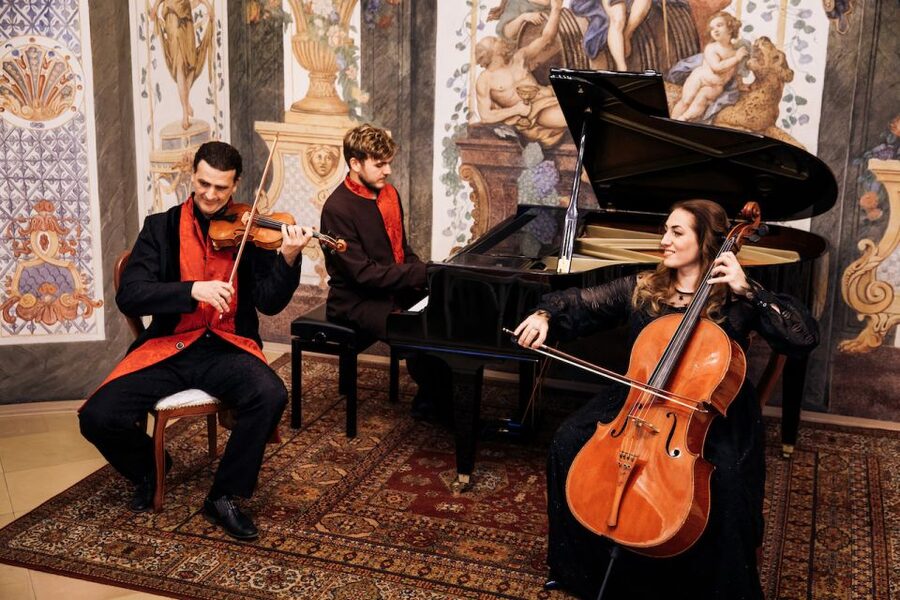
The room’s frescoes give the concert a strong sense of place. You are not entering a modern theater designed to disappear behind the performance. Instead, the painted walls and compact layout remain part of the experience. That setting suits a program built around intimate music, especially the piano, violin, and cello pieces that depend on tone, touch, and conversation between instruments.
The room is relatively small, which has two practical effects. You may feel close to the musicians, especially with a seat nearer the front. At the same time, a compact venue can make seat selection important. You have the option of student tickets, back-row tickets, or seats closer to the performers, so think about your priorities before paying.
If you care most about price, the back row may be perfectly sensible. If you want to watch the players’ hands and expressions, a closer seat is likely worth considering. The exact view depends on the seating arrangement, but the venue’s intimate character is central to the evening.
More Concerts in Vienna
- Vienna: Vivaldi’s Four Seasons Concert in Karlskirche
★ 4.7 · 14,951 reviews - Vienna: Classical Concert in the World-Famous Musikverein
★ 4.6 · 6,673 reviews - Vienna: Classical Concert at St. Stephen’s Cathedral
★ 4.1 · 4,177 reviews
What the 90-minute program actually gives you
This is not a single-composer recital. The program moves across several centuries and styles, using familiar names to create a varied musical evening. You hear Haydn, Beethoven, Mozart, Liszt, Chopin, Bach, Paganini, Saint-Saëns, Massenet, and Schubert.
That variety helps if you want a taste of classical music rather than a demanding study of one composer. You get romantic piano works, elegant chamber music, a cello suite, a violin caprice, and arrangements that shift the mood several times during the performance.
The concert opens with Haydn’s Trio all’ungarese, Hob XV:25. Its three sections include an Andante, a Poco Adagio, and a Rondo finale. This gives the performance a chamber-music foundation, with the instruments responding to one another rather than simply placing the piano at the center.
Beethoven follows with the Adagio from the Moonlight Sonata. It is one of the evening’s quietest and most recognizable moments. The piece works particularly well in a small room, where a soft piano line does not have to compete with a large hall. You can expect a reflective pause after the lively opening trio.
Mozart’s La tartine de beurre, also known as Das Butterbrot, adds a lighter touch. The title refers to a playful miniature, and its presence keeps the program from becoming too solemn. This is a useful change of pace before Beethoven’s Sonata Op. 2, performed with the Allegro con brio movement.
The Beethoven sonata brings more drive and contrast. If the Moonlight Sonata supplies stillness, the Allegro con brio offers energy and forward motion. Hearing both in one program lets you notice two different sides of Beethoven without needing a long explanation from a presenter.
Liszt, Chopin, and the most romantic part of the evening
Liszt’s Un sospiro is one of the program’s centerpieces. The title means a sigh, and the work is known for its flowing, delicate piano writing. It suits the concert’s romantic theme without turning the evening into a collection of only slow pieces.
Chopin receives two places on the program. The Nocturne in C minor, Op. 48 No. 1, brings a dark and expressive mood, while the Étude Op. 10 No. 1 in C major demands speed, control, and a wide reach across the keyboard.
These two Chopin works are a smart pairing. The nocturne gives you melody and atmosphere. The étude shows technical force. Dushan Sretovic is described as a multiple award-winning piano virtuoso who performs internationally, with Chopin interpretations as a regular part of his work. If you come mainly for Chopin, his presence is an important reason to consider this concert.
The piano repertoire also makes the ticket category worth thinking about. In a close room, you can see the physical work behind the music, particularly during Liszt and Chopin. A front seat is not required for good sound, but it may make the performance feel more immediate.
Bach, Paganini, and a change in texture
The program then shifts away from piano-centered romantic works. Bach’s Cello Suite in G major, BWV 1007, includes the Allegro. A solo cello changes the room’s sound at once, replacing the layered texture of a trio or piano recital with one sustained melodic line.
This is a good point in the program for listeners who enjoy hearing the character of the cello itself. The suite is also a reminder that the concert is not limited to the romantic era suggested by its title. It reaches back to Bach and lets the evening breathe before the next burst of virtuosity.
Paganini’s Caprice 13 brings that burst. Paganini’s caprices are associated with difficult violin technique, and this piece gives the violinist a chance to display speed, precision, and control. Claudio Bentes is named as the violinist whose playing carries the concert’s central promise.
The program also includes Saint-Saëns’s The Swan and Massenet’s Thais Meditation. Both are lyrical, graceful works, and both offer a gentler counterweight to Paganini. The Meditation from Thais is especially familiar to many listeners for its singing violin line, while The Swan is tied to the cello’s warm, vocal sound.
Teodora Miteva is presented as an outstanding soloist with numerous international competition wins. Her participation adds another reason to pay attention to the string works, particularly if you are choosing the concert for violin and cello as much as for piano.
More concerts:
- Vienna: Mozart Concert at the Golden Hall
★ 4.6 · 3,986 reviews - Vienna: Classical Concert in St. Anne’s Church (Annakirche)
★ 4.6 · 3,414 reviews - Vienna: Classical Concert at Mozart’s First House
2,423 reviews - Vienna: Mozart and Strauss Concert at Schönbrunn
★ 4.5 · 2,364 reviews
Schubert closes with chamber music
The final listed work is Schubert’s Trio in E flat major, Op. 100, Andante con moto. This is a fitting close because it brings the three instruments back together after the solo works.
The Andante con moto is thoughtful and spacious, with the piano, violin, and cello sharing the musical conversation. Ending with Schubert also returns the program to the chamber-music feeling established by Haydn at the beginning.
The full sequence is well suited to a first classical concert in Vienna. You get famous works, but not only the obvious ones. You also get short pieces that show different instruments and styles. The trade-off is that the program may feel like a sampler rather than a fully developed story about romantic music. If you want one long Beethoven sonata or an entire evening of Chopin, this is not that kind of event.
The sound and the close-up experience
The strongest practical point is the acoustics. A small venue can sometimes feel cramped or produce uneven sound, but the reported experience here is the opposite: notes remain clear, with enough depth to keep the performance from feeling flat.
That matters for this particular program. Beethoven’s soft piano writing, Chopin’s layered runs, and the cello’s lower register all need clean sound. Good acoustics also make a close seat more appealing, since you can hear detail without relying on amplified sound.
The intimate layout brings you physically near the musicians. I like this for chamber music because you can see how the players work together. A violinist’s bow, a cellist’s posture, and the pianist’s movement all become part of the evening, not distractions from it.
Still, closeness is not automatically better for every person. Some people prefer a wider view and a little distance, especially during a 90-minute performance. That is where the back-row option can make sense. You may lose some visual detail, but you still benefit from the room’s clear acoustics.
Names worth knowing before the performance
Several performers are associated with this concert. Claudio Bentes is identified as the violinist. Dushan Sretovic is the piano virtuoso noted for his Chopin work and international appearances. Teodora Miteva is presented as a soloist with multiple international competition wins.
You should treat those descriptions as useful clues rather than a guarantee that every listed artist performs every date in exactly the same role. The program information identifies the musicians, but it does not give a full performance schedule by individual work.
For you, the practical point is simple: this is not background music in a restaurant. The event is built around trained soloists and demanding repertoire. Paganini, Chopin, Liszt, and Beethoven all call for a high level of control, while the trio pieces require close musical timing between performers.
Price, seating, and what is included
At $69 per person, the concert sits in the moderate range for a central Vienna cultural evening. The value depends on how much you want the setting and convenience. You are paying for a 90-minute live performance in a historic room, a program packed with major composers, and a location very close to the city’s best-known cathedral.
The price is easier to justify if you already plan to be in central Vienna. You do not need to build a separate transport plan around the event. The venue is near St. Stephen’s Cathedral, and the meeting point is clear once you find the Deutschordenskirche gate and its concert poster stand.
A cloakroom is included, which is useful if you are coming from a day of sightseeing in a coat or carrying extra layers. The concert itself is included, but refreshments are not. During the break, drinks can be bought outside for cash, and the signage for the toilets may not be obvious. Bring some cash if you want a drink, and ask staff for directions rather than wasting break time searching.
Student tickets may lower the cost for eligible visitors. Back-row tickets offer another way to keep spending in check. Seats closer to the performers cost more, but they may be worthwhile if seeing the musicians matters as much as hearing them.
Timing, arrival, and access
Plan to arrive 15 minutes before the stated start time. That gives you time to find the correct gate, check your coat, and settle into the room without rushing.
The host or greeter can communicate in English or German. That makes the arrival process easier for international visitors, though the venue entrance still deserves attention. Do not simply look for a large concert hall sign. Enter through the gate at Deutschordenskirche, near the poster stand for concerts at Mozarthaus.
The performance lasts 90 minutes. The information notes a break, and the supplied program gives enough material for a full concert rather than a short musical demonstration. Starting times vary, so check availability for the date you want.
The activity is wheelchair accessible. If you need a specific seating arrangement, it is sensible to confirm the details when booking, since the information provided does not describe the exact accessible route or seating location.
Free cancellation is available up to 24 hours before the concert for a full refund. You can also reserve now and pay later, which helps if your Vienna schedule is still shifting.
Who will enjoy this concert most
I would recommend it to you if you want classical music without committing to a full opera or a much longer concert. The 90-minute length fits neatly into a city break, and the location works well after time around St. Stephen’s Cathedral.
It is also a strong choice for listeners who want familiar composers in one sitting. You can hear Beethoven, Chopin, Mozart, Liszt, Schubert, and Brahms in the advertised theme, while the detailed program adds Haydn, Bach, Paganini, Saint-Saëns, and Massenet.
The concert may suit couples especially well because the mood is romantic, the room is historic, and the repertoire includes many lyrical works. It also suits solo visitors who want a polished cultural evening without needing to understand German.
I would be more cautious if you want refreshments included, a large theatrical production, or a single uninterrupted work. The break-time cash arrangement is a minor nuisance, and the compact venue may not provide the grand scale some people expect from a Vienna concert.
Should you book the Romantic Classics concert?
Book it if you value clear acoustics, close seating, and a central historic venue more than a large production. The 4.7 rating from 60 reviews, along with repeated praise for the musicians, sound, and room, supports its appeal.
For the best value, choose a back-row ticket if you mainly want to listen. Pay more for a closer seat if watching the performers is part of the pleasure. Arrive early, carry cash for any break-time drink, and use the Deutschordenskirche gate rather than assuming the entrance will be obvious.
This is a compact, varied introduction to Vienna’s classical sound. It gives you famous melodies, serious musicians, and a room that adds atmosphere without requiring a whole night of formal theater.
FAQ
How long does the concert last?
The concert lasts 90 minutes.
Where is the concert held?
It is held in the Sala Terrena, reached through the gate at Deutschordenskirche in central Vienna.
How far is the venue from St. Stephen’s Cathedral?
The venue is 150 meters from St. Stephen’s Cathedral.
How early should I arrive?
You should arrive 15 minutes before the concert begins.
What languages are available at the venue?
The host or greeter can communicate in English and German.
Is the concert wheelchair accessible?
Yes, the activity is listed as wheelchair accessible.
What types of tickets are available?
You can choose from student tickets, back-row tickets, and tickets closer to the performers.
Is a cloakroom included?
Yes, cloakroom service is included.
Are refreshments included?
No. Refreshments are not included in the concert price and may be bought separately during the break with cash.
Can I cancel the booking?
Yes. You can cancel up to 24 hours in advance for a full refund. You can also reserve now and pay later.
Just added around Vienna
- Mobile puzzle rally tour at the Vienna Central Cemetery★ 4.5 · 3 reviews
- RAXI (E-Rickschaw) big private Vienna tour★ 4.5 · 3 reviews
- 8 days European Highlights PRIVATE TOUR from Budapest including Budapest Vienna Prague and Bratislava★ 5.0 · 3 reviews
- Private Transfer from Vienna to Prague with 1 hour Stop in Kutna Hora★ 4.5 · 3 reviews
- Palais Lobkowitz Audio Guide Tour★ 4.0 · 3 reviews
- Private Tour from Vienna to Melk and Dürnstein★ 4.5 · 3 reviews
- Vienna: Designer Fashion Time Capsule Experience★ 5.0 · 3 reviews
- Vienna Sight & Gourmet Tour – individual private tour★ 4.5 · 3 reviews
Concerts, compared.
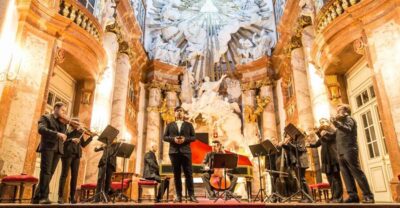
Vivaldi’s Four Seasons Concert in Karlskirche
Read our review →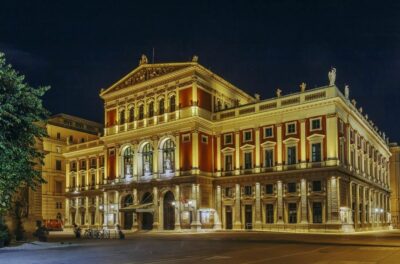
Classical Concert in the World-Famous Musikverein
Read our review →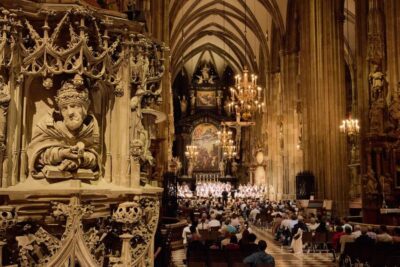
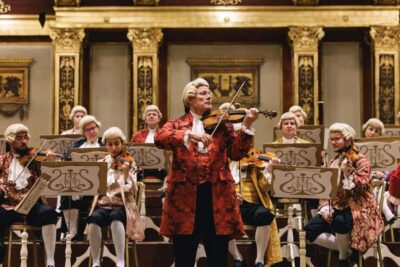
Classical Concert in St. Anne’s Church (Annakirche)
Read our review →
Browse the lists this tour appears in