Reviewed · TOURS
Future Bus Tours – Vienna’s highlights bus tour with virtual reality
History gets a modern makeover. Future Bus Tours packs Vienna’s grand Ringstrasse, Hofburg, Votivkirche, and State Opera into one air-conditioned one-hour ride, then adds virtual reality scenes with Austrian rulers. I like the efficient route and the clever mix of real views with filmed historical characters. I also like the small group size, capped at 18 people, which should make headset instructions easier to follow.
The main caution is the language information. The tour advertises audio in several languages, but one Japanese-speaking customer found only German and English available on the day. I would confirm your language before booking, especially if the commentary is central to your enjoyment.
In This Review
- Key points at a glance
- What Future Bus Tours is trying to do
- Starting beside Albertinaplatz at Operngasse 4
- Heldenplatz and the Hofburg: generals and an empress
- Rathaus, the Burgtheater, and Vienna’s café culture
- The Ringstrasse from the comfort of the bus
- Votivkirche and the assassination attempt
- MuseumsQuartier and the return to the State Opera
- How the VR experience changes the tour
- Audio languages, comfort, and group size
- Who should book this Vienna tour?
- Should you book Future Bus Tours?
- FAQ
- How long does the Vienna VR bus tour last?
- Where does the tour begin?
- Where does the tour end?
- How much does the tour cost?
- What landmarks does the route include?
- How many virtual reality stops are included?
- Are admission tickets to the buildings included?
- What languages are available?
- How many people can join the tour?
- Is the tour canceled if I change my plans?
Key points at a glance
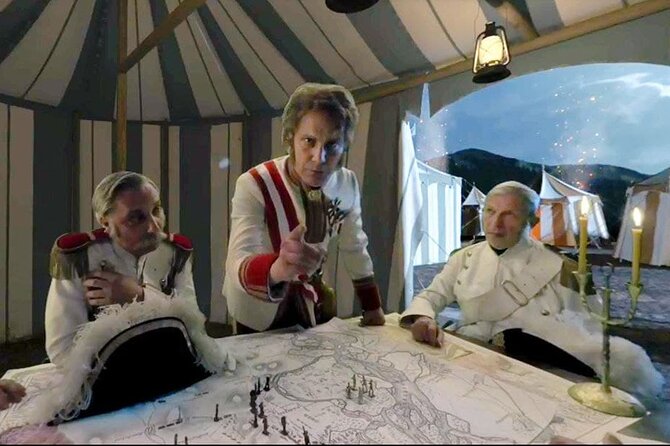
- Four VR stops: Meet Austrian rulers and experience a private-style virtual concert inside the Vienna State Opera through the headset.
- A fast Ringstrasse sampler: See the Opera, Parliament, Rathaus, University of Vienna, Hofburg area, and Votivkirche in roughly one hour.
- Small vehicle, limited group: The maximum group size is 18 people, a useful advantage over large sightseeing buses.
- History with a theatrical twist: Actors portray scenes from Vienna’s past, helping turn dates and names into something easier to remember.
- Good central location: The tour starts and ends at Operngasse 4, beside Albertinaplatz and close to the State Opera.
- A language detail to check: The supplied information gives different totals for available languages, so verify the current options before paying.
What Future Bus Tours is trying to do
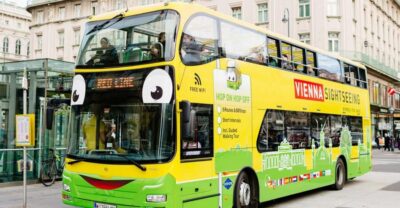
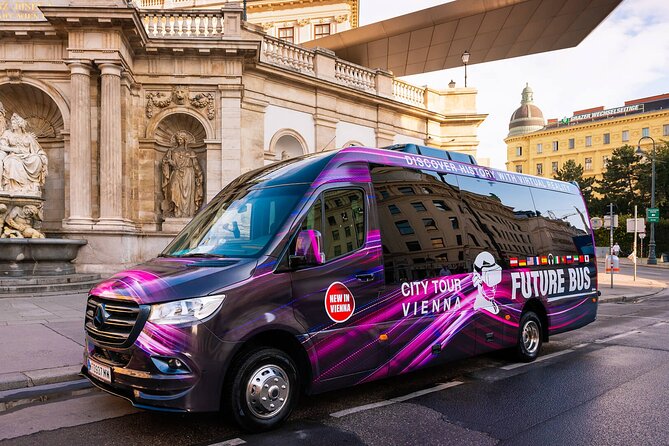
This is not a traditional hop-on, hop-off sightseeing bus. You do not spend the day getting off at every major sight. Instead, you remain with the vehicle for about an hour, pause at selected locations, and use a supplied VR headset to see short historical scenes.
That format works well if you have limited time in Vienna. The city center is packed with monumental buildings, and walking between all of them can take longer than expected. From the bus, you get an organized circuit with commentary, while the headset supplies the unusual part: historical figures appear in staged scenes connected to the places around you.
I like this approach for a first look at Vienna. You see enough to decide which buildings deserve a closer visit later. You should not treat it as a substitute for entering the Hofburg, exploring the State Opera, or walking the Ringstrasse on foot. It is a brisk introduction, not a full museum or palace visit.
The cost is $32.10 per person. That is reasonable if you value convenience, air conditioning, and the VR production. It is less compelling if you only want a basic city circuit, since much of the route can also be covered by walking and public transport. The VR element is what gives this tour its value.
A few more trips of this kind worth comparing:
- Vienna: Vivaldi’s Four Seasons Concert in Karlskirche
★ 4.7 · 14,951 reviews - Vienna: Spanish Riding School Training
★ 3.9 · 9,281 reviews - Vienna: Skip-the-cashier-desk-line Giant Ferris Wheel Ride
★ 4.5 · 7,859 reviews
Starting beside Albertinaplatz at Operngasse 4
The meeting point is Operngasse 4, 1010 Vienna, right by Albertinaplatz. This puts you near the State Opera and in the central Innere Stadt, a useful location if you are already exploring Vienna’s core.
At the start, you receive instructions for the headset and the virtual reality experience. That briefing matters. The tour moves quickly, and you will get more from the scenes if you know when to put the headset on and where to look.
The vehicle returns to this same meeting point at the end. That makes planning simple. You can pair the tour with a visit to the Albertina area, a walk around the Opera, or a meal nearby. The location is also near public transportation, so getting to the departure point should be straightforward.
The tour uses mobile tickets, and confirmation is provided when you book. Keep the ticket easy to reach on your phone.
Heldenplatz and the Hofburg: generals and an empress
The first major stop is Heldenplatz, the broad square in front of the Hofburg Palace. This is one of Vienna’s most politically charged open spaces, framed by the Hofburg complex and monumental architecture.
Here, the VR presentation introduces three important Austrian rulers: two generals and an empress. The staged scenes are designed to make the past feel immediate rather than distant. You are not simply listening to a list of names through headphones. You see actors portray people connected to Vienna’s imperial story.
The nearby Maria-Theresien-Platz adds another layer. Its large monument honors Maria Theresa, one of Austria’s most important rulers. The audio guide and VR presentation connect her image to the wider story of the city.
This stop is likely to be strongest for anyone who enjoys political history and royal personalities. It also gives you a good look at the Hofburg area without requiring a palace admission. Keep in mind that admission tickets to sights are not included, and this tour does not appear to take you inside the Hofburg.
The drawback is time. Ten minutes is enough for an introduction and a VR scene, but not enough for a careful look at the square, palace entrances, or monument. If you want photographs, you will need to work quickly.
Rathaus, the Burgtheater, and Vienna’s café culture
The route continues along the Ringstrasse, Vienna’s grand boulevard of public buildings. The Vienna City Hall, or Rathaus, is one of the most recognizable structures on the circuit. Its tall Gothic-style façade gives the bus ride a strong visual moment, even if you do not enter.
The nearby Burgtheater brings the tour’s second VR stop. The theatre sits close to the Volksgarten and Café Landtmann, one of Vienna’s best-known café addresses. The presentation connects this area with another important historical personality whose office was nearby and whose favorite café was across the street.
The supplied details do not name that person, so you should expect the audio guide and headset to provide the explanation during the stop. That small mystery is part of the fun, but it also means you will want to pay close attention.
This section shows why the tour is more than a drive past buildings. Vienna’s political, artistic, and café life often sat within a few blocks of one another. A city hall, theatre, formal garden, and café can all become part of the same historical story.
The practical limitation is that you are seeing the Burgtheater from outside. The stop does not include a theatre ticket, and the bus remains your base. If you want to inspect the interior or spend time in the Volksgarten, plan a separate visit.
A completely different kind of day out in Vienna:
- Vienna: Schönbrunn Palace & Gardens Skip-the-Line Tour
★ 4.7 · 7,739 reviews - Vienna: Light of Creation Votive Church Immersive Light Show
★ 4.8 · 6,779 reviews - Vienna Spanish Riding School Guided Tour
★ 4.7 · 6,765 reviews - Vienna: Classical Concert in the World-Famous Musikverein
★ 4.6 · 6,673 reviews
The Ringstrasse from the comfort of the bus
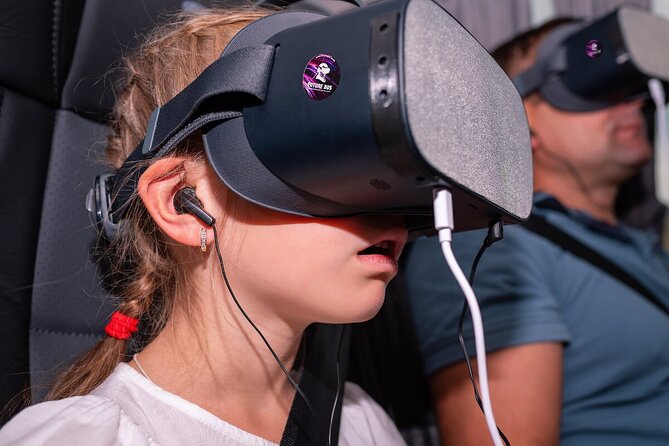
The Ringstrasse is the backbone of the tour. Along it, you pass the Vienna State Opera, Parliament, City Hall, University of Vienna, and other major buildings.
This is where the air-conditioned transport earns its keep. Vienna’s center is easy to walk, but a concentrated hour on the Ringstrasse lets you cover more ground without using your feet. You can sit back, look out the window, and listen to the audio guide.
The bus is especially useful for a first orientation. You begin to understand how the monumental buildings relate to one another, rather than seeing them as isolated stops on a map. The route also gives you a chance to note places you want to revisit at a slower pace.
The vehicle is not a large coach, and the maximum group size is 18. That should create a more personal feel and reduce some of the confusion that can come with a crowded sightseeing bus. Still, this is a moving city tour. Traffic, passing views, and short stops mean you should not expect every building to receive equal attention.
The audio guide is offered in multiple languages, but the supplied information is inconsistent. One section says seven languages, another says nine, and a Japanese-speaking customer reported hearing only German and English. Check the exact language selection before booking. That is the most important practical issue in the entire experience.
Votivkirche and the assassination attempt
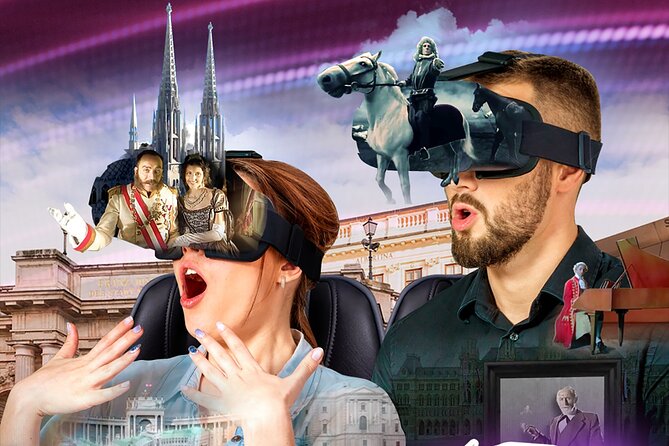
The third VR stop is at Votivkirche, one of Vienna’s striking neo-Gothic churches. Its tall twin towers and ornate exterior make it easy to recognize, but it receives less attention than the Hofburg, Opera, and Rathaus.
The tour uses the church to tell a dramatic story involving an assassination attempt. That connection gives the building more meaning than a quick photograph from a passing vehicle. The headset helps connect the event to the place, while the audio guide fills in the basic story.
I like this choice of stop because it moves beyond Vienna’s usual imperial highlights. You still see a major monument, but you also get a piece of the city’s political past tied to a less frequently visited landmark.
Again, the time is short. Ten minutes may cover the VR presentation and a look at the church, but it will not allow a full interior visit. Admission is not included. If Votivkirche catches your attention, return later and explore it separately.
MuseumsQuartier and the return to the State Opera
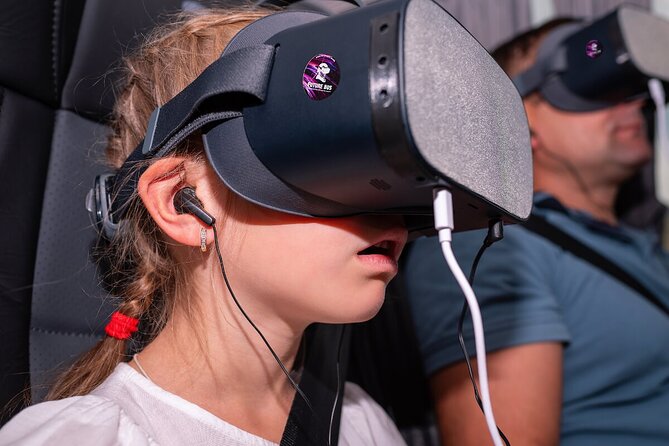
After the Ringstrasse section, the bus leaves the boulevard and passes MuseumsQuartier. This is one of Vienna’s modern cultural districts, with several museums gathered in a former imperial setting.
The route does not promise museum entry, so think of this as a visual introduction. You get a sense of how Vienna combines old court architecture with newer cultural spaces. That contrast gives the ride a useful change of pace after the grand formal buildings along the Ring.
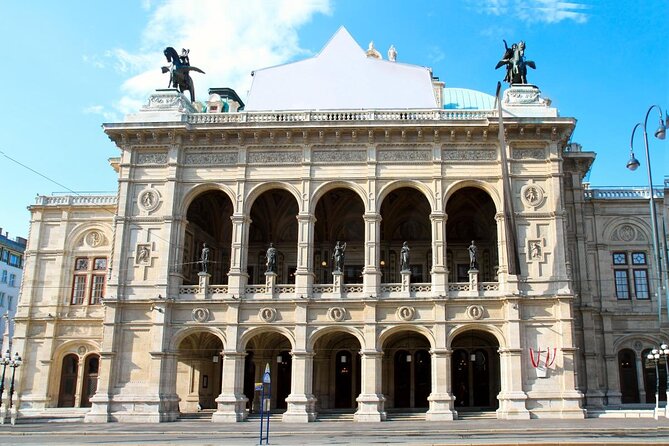
The bus then returns toward the State Opera and Albertinaplatz for the fourth and final VR stop. Here, you meet one of Vienna’s best-known emperors and his wife. The presentation ends with a virtual concert inside the opera house, a fitting finale for a tour that mixes imperial figures, architecture, and performance.
This final segment may be the most memorable for people who enjoy theatre and music. It offers something you would not get from a standard recorded city commentary: a staged performance connected to one of Vienna’s most famous buildings.
The experience is virtual, not an actual opera visit. You will not receive a State Opera admission ticket, and the tour does not replace a live performance. But as a short closing scene, it gives the route a clear finish rather than simply ending after a circuit of buildings.
How the VR experience changes the tour
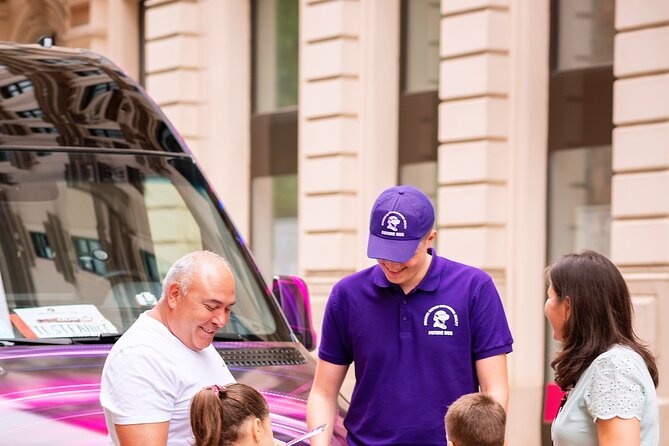
The headset is the reason to choose this tour over a standard sightseeing ride. The scenes use actors to portray people from Vienna’s past, and the three-dimensional effect lets you see historical moments in a more theatrical way.
That does not mean every person will enjoy the technology equally. If you prefer quiet observation, traditional guiding, or long stops for photography, the headset may feel like a distraction. If you enjoy films, interactive museums, or unusual presentations, it adds a welcome bit of energy.
I would think of the VR scenes as short historical performances. They do not give you every detail about Austria’s rulers or the buildings along the route. Instead, they provide memorable snapshots that can help you remember what you saw.
The tour’s strongest praised feature is this combination of entertainment and history. The attack on the emperor, the rulers at Heldenplatz, and the opera concert give the hour a clear sequence of dramatic moments. That is why the experience can work well for families and for adults who find conventional audio tours too flat.
Audio languages, comfort, and group size
The audio guide is available in several languages, and the tour promotes a choice of seven or nine depending on the supplied description. Because those numbers do not match, I would not rely on a language being available without checking first.
The Japanese-language problem is worth taking seriously. One customer booked expecting Japanese audio but found only German and English. The experience itself was still considered inventive and interesting, but the language mismatch reduced the value. If you need a specific language, get confirmation before the cancellation deadline.
The air-conditioned vehicle is another practical plus. You spend the full hour seated, moving between stops instead of walking in the weather. This can be helpful after a long day of sightseeing, though it also limits how much time you have on the ground.
Most people can participate, and the maximum group is 18. The activity is near public transportation. No special accessibility details are provided, so you should ask Future Bus Tours directly if you have mobility or equipment concerns.
Who should book this Vienna tour?
I would recommend it to you if you want a quick orientation to central Vienna, enjoy technology-based storytelling, or have only a short window before a train, meal, or other activity. It also suits families and mixed-age groups because the VR scenes add a clear visual hook.
It is a good choice for repeat visitors who have already seen the main buildings and want a different way to connect them. The route includes familiar sights, but the presentation gives them a new angle.
You may want to skip it if you dislike headsets, need long photo stops, or want to enter the Hofburg, Votivkirche, Rathaus, or State Opera. You will see these places from the bus or at brief stops, but entry tickets are not part of the experience.
At $32.10, the tour offers fair value when you count the air-conditioned ride, audio commentary, small maximum group, and four VR presentations. The price is harder to justify if you only want transport past landmarks. The technology and staged history are the main reason to pay for this particular hour.
The cancellation terms are forgiving: you can cancel for a full refund up to 24 hours before the start time. Changes or cancellations made inside that window are not accepted for a refund.
Should you book Future Bus Tours?
Book this tour if you want Vienna’s main sights in a compact format and the idea of seeing Austrian history through VR sounds appealing. The four headset stops, especially Heldenplatz, Votivkirche, and the final opera scene, give the ride more personality than a standard city loop.
Before paying, confirm the audio language you need. If that point is settled, this is a smart first-day activity or a useful rainy-weather option. If your priority is detailed guiding, interior visits, or relaxed photography, spend the money on a walking tour and separate museum admissions instead.
FAQ
How long does the Vienna VR bus tour last?
The tour lasts approximately one hour.
Where does the tour begin?
It begins at Operngasse 4, 1010 Vienna, beside Albertinaplatz.
Where does the tour end?
The activity ends back at the original meeting point near Operngasse 4.
How much does the tour cost?
The listed price is $32.10 per person.
What landmarks does the route include?
The route includes Heldenplatz, the Hofburg entrance, Maria-Theresien-Platz, Rathaus, the Ringstrasse, Votivkirche, MuseumsQuartier, and the Vienna State Opera area.
How many virtual reality stops are included?
There are four virtual reality stops during the tour.
Are admission tickets to the buildings included?
No. Admission tickets are not included for the stops.
What languages are available?
The tour information gives different totals, listing seven languages in one place and nine in another. One Japanese-speaking customer found only German and English available, so confirm your required language before booking.
How many people can join the tour?
The maximum group size is 18 people.
Is the tour canceled if I change my plans?
You can cancel up to 24 hours before the start time for a full refund. Cancellations or changes made less than 24 hours before the start time are not accepted for a refund.
Just added around Vienna
- Mobile puzzle rally tour at the Vienna Central Cemetery★ 4.5 · 3 reviews
- RAXI (E-Rickschaw) big private Vienna tour★ 4.5 · 3 reviews
- 8 days European Highlights PRIVATE TOUR from Budapest including Budapest Vienna Prague and Bratislava★ 5.0 · 3 reviews
- Private Transfer from Vienna to Prague with 1 hour Stop in Kutna Hora★ 4.5 · 3 reviews
- Palais Lobkowitz Audio Guide Tour★ 4.0 · 3 reviews
- Private Tour from Vienna to Melk and Dürnstein★ 4.5 · 3 reviews
- Vienna: Designer Fashion Time Capsule Experience★ 5.0 · 3 reviews
- Private day trip from Munich to Eagle’s Nest & Hallstatt★ 4.7 · 3 reviews
Tours, compared.

Schönbrunn Palace & Gardens Skip-the-Line Tour
Read our review →

Skip-the-Line Sisi Museum, Hofburg and Gardens Tour
Read our review →
Skip-the-Line Schönbrunn Palace & Gardens Tour
Read our review →

Guided Walking Tour of City Center Highlights
Read our review →