
Reviewed · CITY TOURS
Terrible crimes in Vienna, hidden secrets of the inner city
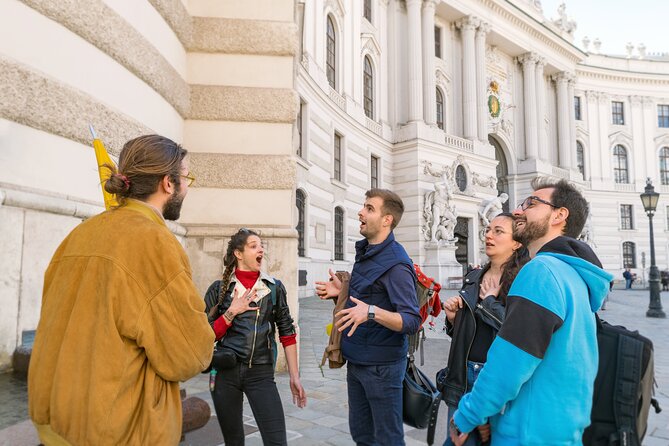
Vienna keeps its darkest stories under gilded stone. This offbeat walk takes you through the inner city’s crimes, scandals, punishments, and political violence, using familiar streets as clues to a less polished past. I like the way the tour links each crime to its period, and I like that it leads you to overlooked corners, old walls, fountains, and buildings you might otherwise pass without notice.
At $46.13 per person, the price is fair if you enjoy true crime and serious city history, though it is not a cheap sightseeing stroll. The subject matter is often grim, and the pace may feel brisk because the advertised tour lasts about two hours while the listed stop times add up to more than that.
In This Review
- Key points to know before you go
- Why Vienna’s dark side makes a good walking tour
- Starting at the Capuchin monastery and Trattnerhof
- Palais Bathory and the story of the Blood Countess
- Demel, Udo Proksch, and the Lucona affair
- Two grim Herrengasse stories
- Molker Bastei and the murder of Anna Gaugisch
- Revolution at Am Hof
- The Hannakenkönig and a strange medical scam
- Maria Am Gestade and Vienna’s last wheeling
- Jealousy, torture, and the Hoher Markt
- Bakers, witches, and medieval punishment near St. Stephen’s
- Himmelpfortgasse and a Viennese Romeo and Juliet
- How the price, pace, and group size affect value
- Who should book this crime walk
- Should you book Terrible crimes in Vienna?
- FAQ
- Where does the tour begin?
- Where does the tour end?
- How long does the experience last?
- What language is offered?
- Is a mobile ticket available?
- Is an audio guide included?
- How many people can join the tour?
- Are admission tickets required at the stops?
- Is the tour suitable for children?
- Can I cancel for a full refund?
Key points to know before you go
- Fourteen crime stories in Vienna’s old center: The route covers everything from medieval punishment to a twentieth-century espionage scandal.
- Guide Ben adds original research: The tour’s stories are presented with a personal, well-researched approach rather than a standard sightseeing script.
- Mostly an outdoor history walk: You visit streets, squares, façades, fountains, and former sites, not a series of indoor attractions.
- The route reaches places many visitors skip: Molker Bastei, Hannaken-Brunnen, Maria Am Gestade, and Himmelpfortgasse add local texture.
- A complimentary smartphone audio guide is included: That gives you another way to follow the story and keep details at hand.
- Best for adults and older teens: Several cases involve murder, torture, execution, dismemberment, and political violence.
Why Vienna’s dark side makes a good walking tour
Vienna is famous for imperial palaces, classical music, coffeehouses, and grand Baroque façades. This tour looks behind that polished surface without pretending the city was ever simply elegant and orderly.
The crimes are not presented as random shocks. They show how Vienna’s laws, class structure, religious beliefs, politics, and public life changed over time. A murder case introduces nineteenth-century celebrity culture. A spy scandal exposes weaknesses in the Habsburg military. Medieval punishments show how public justice once worked.
I especially like this format because the city itself becomes the museum. You stand near a palace, a fountain, or a cathedral and hear what happened there. The physical setting helps the stories stay with you.
The route is also useful for repeat visitors. If you have already seen St. Stephen’s Cathedral, the Hofburg, and the main shopping streets, this walk gives you a reason to look again. You may notice a former monastery site, a surviving piece of city wall, or a building linked to a scandal that does not appear in most guidebooks.
More City Tours in Vienna
- Vienna: Guided Walking Tour of City Center Highlights
★ 4.7 · 4,989 reviews - Vienna: City Cruise with Optional Lunch
★ 3.4 · 3,982 reviews - Vienna: City Cruise
★ 3.3 · 2,978 reviews
Starting at the Capuchin monastery and Trattnerhof
The tour begins at Helmut-Zilk-Platz, near Albertina, then moves into Vienna’s central streets. One of the first stops is Tegetthoffstraße 2 and the Capuchin monastery.
Here you hear about Father Innocentius and the discovery of a monastery dungeon. Monks were reportedly locked away for years, sometimes for reasons that sound astonishingly minor today, such as taking an unauthorized afternoon walk or abusing a monastery official.
The story takes an unexpected turn when Father Innocentius told Emperor Joseph II about the dungeon. The emperor closed it and sent the priest to Lviv for his safety. His later life included Protestantism, Freemasonry, and service as an adviser to the tsar. That is a lot of plot for one monastery basement.
At Trattnerhof, the focus shifts to the Jaroszynski murder case and actress Therese Krones. Krones was pulled into the scandal and saw her career damaged, while rumors blamed her supposed extravagance for Jaroszynski’s crime.
The more grounded explanation was gambling and heavy debt. That distinction matters. The tour does not simply repeat the most dramatic version of a case. It also looks at how gossip and public opinion could destroy someone who was not really responsible.
Palais Bathory and the story of the Blood Countess
At Augustinerstraße 12, you reach Palais Bathory, associated with Elisabeth Bathory. She is remembered as the Blood Countess, accused of killing hundreds of young women and bathing in their blood to preserve her beauty.
The story comes with an important warning: Bathory may have been one of history’s most dangerous serial killers, or she may have been targeted by a political intrigue designed to remove a powerful and difficult countess. The tour presents that uncertainty rather than treating every famous detail as proven fact.
This is a good example of the tour’s wider appeal. You are not only hearing who died and how. You are also considering who controlled the story, who benefited from the accusation, and how legends grow around notorious figures.
The stop is short, so you should not expect a full lecture on Bathory. It works better as one chapter in a fast-moving sequence.
Demel, Udo Proksch, and the Lucona affair
At Graben and Kohlmarkt, the setting becomes more modern. Near Demel, the tour examines the role of Udo Proksch and the Lucona affair in the 1970s.
A heavily insured freighter was sent toward Asia with an explosive charge hidden on board. The plot led to mass murder and major insurance fraud. The investigation lasted for years, helped along by Proksch’s connections in many directions.
This case adds welcome variety. The route is not limited to medieval cruelty or sensational murders. It shows that corruption, influence, and calculated violence continued into modern Vienna.
For me, this is one of the stronger stops because the setting is so ordinary and central. You are near famous shops and elegant streets, yet the story concerns a carefully planned crime with international consequences. It is a useful reminder that Vienna’s darkest episodes are not all buried in the Middle Ages.
A few more trips of this kind worth comparing:
- Vienna: Vivaldi’s Four Seasons Concert in Karlskirche
★ 4.7 · 14,951 reviews - Vienna: Spanish Riding School Training
★ 3.9 · 9,281 reviews - Vienna: Skip-the-cashier-desk-line Giant Ferris Wheel Ride
★ 4.5 · 7,859 reviews - Vienna: Schönbrunn Palace & Gardens Skip-the-Line Tour
★ 4.7 · 7,739 reviews
Two grim Herrengasse stories
Herrengasse brings two very different cases close together.
At Ferstel Palace, you hear about the former house called Zu den Fünf Morden, the site of one of medieval Vienna’s most notorious mass killings. The murderer killed five people, including a seven-year-old child, and was impaled.
The execution itself became part of the horror. The executioner was inexperienced with this form of punishment, so the process lasted a very long time. This is not a pleasant story, but it reveals how public punishment was designed to terrify as much as to kill.
Across from Palais Ferstel, the former Hotel Klomser marks the end of the Colonel Redl affair. Redl’s suicide closed the monarchy’s greatest spy scandal, one that may have helped shape the road to the First World War.
His espionage exposed the weakness of the underfunded Evidenzbureau, the empire’s secret service, and damaged the army’s reputation. This is a more political story than the earlier murders, but it fits the tour well. A city’s crimes can reveal its institutions just as clearly as its criminals.
Molker Bastei and the murder of Anna Gaugisch
At Molker Bastei, the story concerns Anna Gaugisch, who was murdered and dismembered by her boyfriend Raimund Lewisch in 1861.
Some body parts were found in the Danube and others in a nearby smithy. Lewisch wanted to remove a woman who had become pregnant. Before the murder, other blacksmiths reportedly noticed his behavior after he dissected a cat.
This stop is brief, only about five minutes in the listed schedule, so it is more of a sharp, disturbing interlude than a detailed case study. The location matters because Molker Bastei is part of Vienna’s older defensive edge, a place many people pass without knowing its past.
If you are sensitive to graphic crime stories, this is one of the moments to prepare for. The tour does not soften the material.
Revolution at Am Hof
At Am Hof, the subject changes from private crime to public violence. Theodor Baillet de Latour, the war minister, was lynched during the revolution of 1848.
The killing helped begin the Wiener October Revolution, the more violent final phase of the uprising. The revolution ended with the city being retaken, and the nearby civil arsenal was looted during the turmoil.
This stop gives the tour useful political weight. Vienna was not always the calm imperial capital suggested by its grand architecture. Public anger, military power, and revolution could erupt in the same squares where you now see everyday city life.
The story also connects well with the surrounding streets. You are not being asked to picture an abstract event in a distant textbook. You are standing in the part of the city where the struggle unfolded.
The Hannakenkönig and a strange medical scam
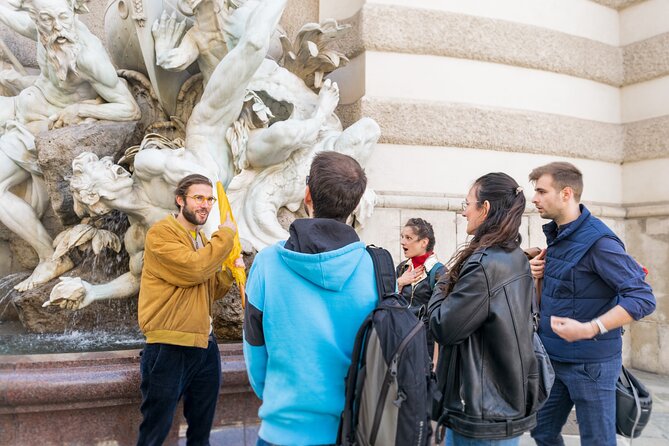
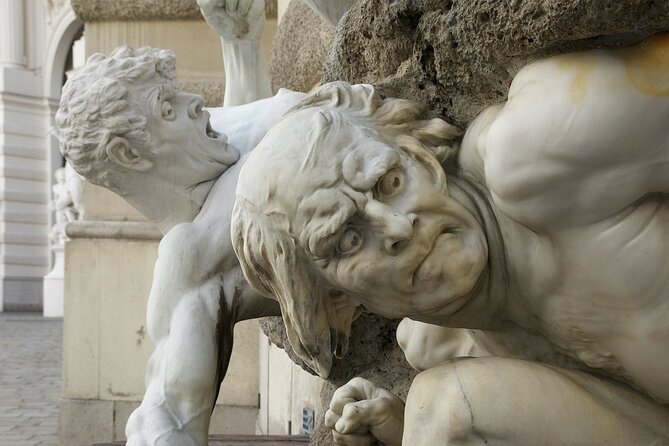
At Hannaken-Brunnen, you hear about a surgeon known as the Hannakenkönig. The Hannaken were a minority from Moravia, and many came to Vienna in search of work.
The fountain shows two men carrying an injured companion to the Hannakenkönig. The disturbing twist is that the surgeon allegedly created injuries himself by setting trip hazards, then profited by treating the people who fell.
This is one of the tour’s more unusual stories. It is less famous than the political scandals and more revealing of how poverty, migration, and medical business could intersect. The fountain gives the story a visual anchor, too.
Because the case is strange rather than traditionally gruesome, it can provide a small break in the darker sequence.
Maria Am Gestade and Vienna’s last wheeling
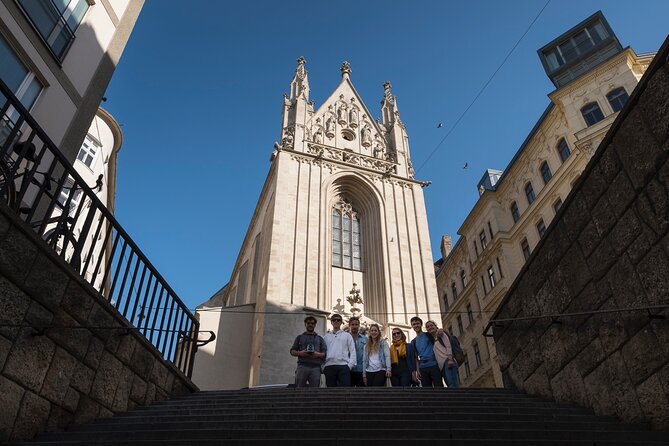
Near Maria Am Gestade, the tour reaches a surviving section of the city wall and the Zahlheim case. The punishment was wheeling, a death penalty considered exceptionally cruel and already disappearing in many countries.
The case is especially notable because it took place under Joseph II, who generally opposed the death penalty. The facts were considered severe enough to force a decision that ran against his usual position.
This stop helps explain how law worked before modern ideas of proportional punishment and humane treatment. It also points out a physical remnant of Vienna’s fortifications, giving you something concrete to look at while hearing about an almost unimaginable execution.
The combination of architecture and law is one of the walk’s strengths. You get a small piece of the old city and a story that explains the harsh society built around it.
Jealousy, torture, and the Hoher Markt
At Hoher Markt, the tour tells the story of Thekla Riener and her husband Anton Grünborn. Grünborn tortured her with instruments from the courthouse because he believed she had a lover.
No such lover existed. His jealousy was based on imagined affairs, and the sequence of violence ended with him accidentally killing her. Her parents reportedly became insane after the tragedy.
This case is less about a clever criminal plot than about the destructive power of obsession. It also shows how official tools of justice could be turned into instruments of private cruelty.
Hoher Markt is a busy and familiar square, which makes the contrast uncomfortable. The location looks open and ordinary today. The story asks you to picture a place where domestic violence and public punishment could overlap.
Bakers, witches, and medieval punishment near St. Stephen’s
At St. Stephen’s Cathedral, the tour examines the supposed standard bread loaf used by Vienna to check the size and quality of bread in the Middle Ages.
Part of the story is legend, but the punishment known as the baptism of bakers was real in some form. Bakers accused of selling poor bread could be placed in a cage and dipped repeatedly into the Danube. Similar punishments for women involved in disputes existed in English-speaking countries.
This stop is a good reminder to separate colorful tradition from documented fact. The bread loaf may attract attention, but the larger point is the harsh public control of trade and reputation.
At Steffl, the former Malefizspitzbubenhaus once contained an executioner’s apartment and dungeon. It was also linked to the Plainacher case, involving the only person burned as a witch in Vienna.
Plainacher was accused of bewitching her epileptic granddaughter and summoning demons. Witch trials were not common in Vienna, but public pressure pushed the city judge to act. Again, the story is as much about fear and social pressure as it is about the accused person.
Himmelpfortgasse and a Viennese Romeo and Juliet
The final stop is Himmelpfortgasse, once the site of the Himmelpfort monastery. In 1319, a nun was walled in because she refused to give up the man she loved, whom her father hated.
The story has the shape of a Viennese Romeo and Juliet. Two rival families had children who were close, but when the mayor’s son asked for Anna’s hand, her father sent her toward a life as a nun instead of accepting the match.
It is a quieter ending than the stories of torture and mass murder. That is welcome. The case brings the focus back to family power, forced choices, and the limited freedom available to women in medieval society.
The walk ends on Rauhensteingasse in the first district, so you remain in central Vienna rather than being left far from public transport or major sights.
How the price, pace, and group size affect value
The cost is $46.13 per person for about two hours. Since there are no separate admission tickets for the stops, you are paying mainly for the guide’s research, storytelling, route design, and the included smartphone audio guide.
I would call that reasonable for people who actively enjoy true crime, unusual history, or themed city walks. It is less appealing if you want interior visits, grand monuments, or a slow architectural tour. This experience is about interpretation, not entry tickets.
The group limit is 20 people. That is small enough to feel more personal than a large coach excursion, though the quality will depend on how clearly you can hear and how well the group moves through central streets.
The schedule deserves attention. The activity is advertised at roughly two hours, but the listed times for the fourteen stops total about 140 minutes before walking between them. In practice, the stops are likely to be approximate, and some stories will be delivered quickly. Plan for a brisk walk and do not expect to linger at every location.
A mobile ticket makes arrival simple, and the meeting point at Helmut-Zilk-Platz is near public transportation. Confirmation is provided at booking. The tour requires good weather and a minimum number of participants. You can cancel for a full refund up to 24 hours before the start time, but late cancellations are not refunded.
Who should book this crime walk
You are a good match if you like:
- True crime presented with historical context
- Unusual stories about famous buildings and squares
- Walking through central Vienna with a clear theme
- Political scandals, old punishments, and local legends
- Tours that appeal to older teens and adults
- A guide who adds research and stories beyond the main landmarks
I would not choose it for young children. Several cases involve torture, sexual violence, murder, dismemberment, and execution. It is also not the right pick if you dislike grisly subjects or want a relaxed coffeehouse-and-palace introduction to Vienna.
The route can pair well with the Vienna Crime Museum, especially if you want more material after the walk. It also suits anyone who has already seen the main imperial sights and wants to understand how ordinary fear, crime, and political conflict shaped the city.
Should you book Terrible crimes in Vienna?
Book it if you want Vienna to feel less polished and more human. The best part is the connection between place and story: a monastery dungeon, a palace, a fountain, a city wall, and a cathedral all become evidence in a larger account of the city.
The walk is strongest for curious adults who value unusual detail over famous sights. Ben’s friendly delivery and independent research add personality, and the route reaches corners you might not find alone.
Skip it if you need a gentle family activity, dislike graphic material, or expect long visits inside historic buildings. At $46.13, it earns its price through storytelling rather than attractions. For the right audience, that is a fair trade.
FAQ
Where does the tour begin?
It begins at Helmut-Zilk-Platz, Albertinaplatz 2-3, 1010 Vienna, Austria.
Where does the tour end?
The tour ends on Rauhensteingasse in Vienna’s first district.
How long does the experience last?
The advertised duration is approximately two hours.
What language is offered?
The tour is offered in English.
Is a mobile ticket available?
Yes. The experience provides a mobile ticket.
Is an audio guide included?
Yes. A complimentary smartphone audio guide is included.
How many people can join the tour?
The tour has a maximum group size of 20 participants.
Are admission tickets required at the stops?
The listed stops have free admission. The experience is primarily an outdoor walking route through central Vienna.
Is the tour suitable for children?
The material is geared more toward teens and adults because it includes murder, torture, executions, dismemberment, and other disturbing subjects.
Can I cancel for a full refund?
Yes, if you cancel at least 24 hours before the experience start time. Cancellations made less than 24 hours in advance are not refunded. If poor weather or insufficient participation cancels the tour, you are offered another date or a full refund.
Just added around Vienna
- Mobile puzzle rally tour at the Vienna Central Cemetery★ 4.5 · 3 reviews
- 8 days European Highlights PRIVATE TOUR from Budapest including Budapest Vienna Prague and Bratislava★ 5.0 · 3 reviews
- RAXI (E-Rickschaw) big private Vienna tour★ 4.5 · 3 reviews
- Private Transfer from Vienna to Prague with 1 hour Stop in Kutna Hora★ 4.5 · 3 reviews
- Palais Lobkowitz Audio Guide Tour★ 4.0 · 3 reviews
- Private Tour from Vienna to Melk and Dürnstein★ 4.5 · 3 reviews
- Vienna: Designer Fashion Time Capsule Experience★ 5.0 · 3 reviews
- Vienna Sight & Gourmet Tour – individual private tour★ 4.5 · 3 reviews
City Tours, compared.

Guided Walking Tour of City Center Highlights
Read our review →

Guided Walking Tour of City Highlights & Hidden Gems
Read our review →
City Sightseeing Tour in an Electro Vintage Car
Read our review →
Skip-the-Line Schonbrunn Palace Guided Tour and Vienna Historical City Tour
Read our review →

Browse the lists this tour appears in