
Reviewed · HISTORICAL TOURS
Time Travel-Magic Vienna History Tour Ticket
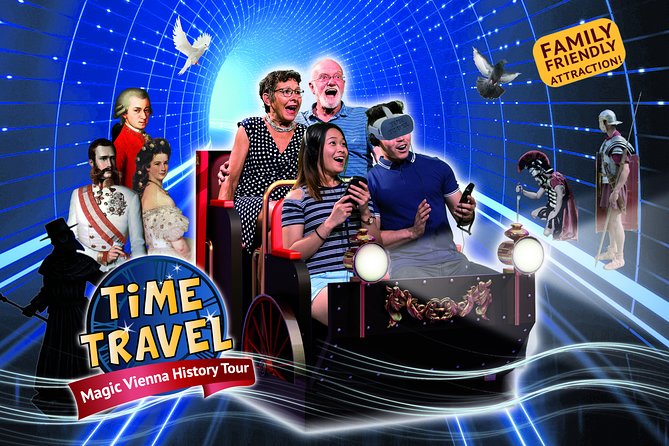
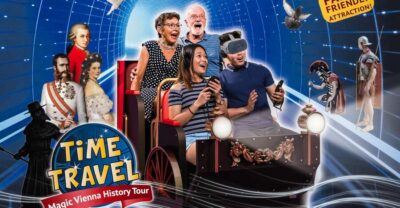
History gets a high-tech makeover here. Time Travel Vienna turns the city’s past into a one-hour show with 5D cinema, virtual reality, animatronics, and live effects, all inside the historic vaults of the Michaelerkloster. You move from Roman Vindobona to the Habsburg court, a plague pit, Mozart and Strauss, World War II, and modern Austria without leaving the building.
I like the way this experience gives you a quick sense of Vienna’s long story before you tackle the city’s palaces and churches. I also like the mix of media, especially the virtual fiaker ride and the 5D cinema. The main drawback is that this is a playful overview, not a serious history lesson, and some adults may find parts too simple or theatrical.
In This Review
- What makes this Vienna history show worth your time
- Inside the Michaelerkloster: where the show begins
- Roman Vindobona: Vienna before the palaces
- The plague pit and medieval Vienna
- Habsburg rulers and the imperial city
- Mozart, Strauss, and Vienna’s musical past
- The air raid shelter and postwar Austria
- The virtual fiaker ride back to today
- Why the special effects work, and where they fall short
- Is $27.76 a good value?
- Who should book Time Travel Vienna?
- My recommendation: book it for fun, not scholarly detail
- FAQ
- How long does Time Travel Vienna last?
- What language is the tour offered in?
- Is admission included with the ticket?
- Does the experience use virtual reality?
- Is Time Travel Vienna suitable for children?
- How many people can join the tour?
- Can I cancel for a full refund?
What makes this Vienna history show worth your time
- A 400-year-old setting: The show takes place in the historic vaults of the Michaelerkloster, adding a real sense of age beneath the modern effects.
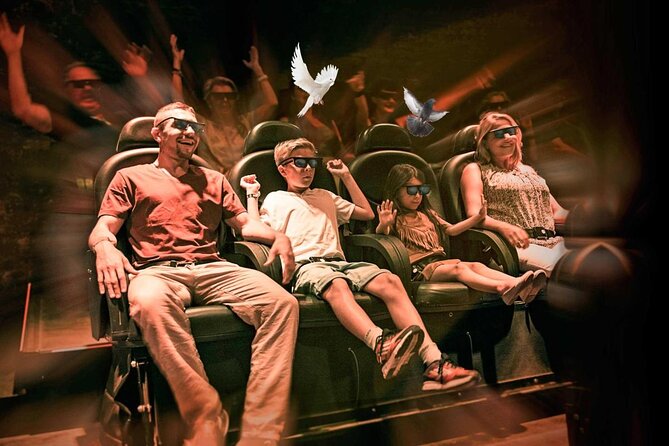
- Several kinds of technology: You move through video, virtual reality, hologram-style presentations, wax figures, robotics, animatronics, and simulated rides.
- A quick trip through key eras: The route covers Roman Vienna, the plague, the Habsburgs, Vienna’s musical tradition, World War II, and postwar Austria.
- A strong family activity: The light tone and short running time work well for children, teens, and adults who want history without a long lecture.
- Ten audio languages: English, Spanish, Italian, French, Japanese, Chinese, Russian, Hungarian, Polish, and Czech are available.
- A useful rainy-day stop: It offers an indoor break close to central Vienna and fits easily between other sights.
Inside the Michaelerkloster: where the show begins
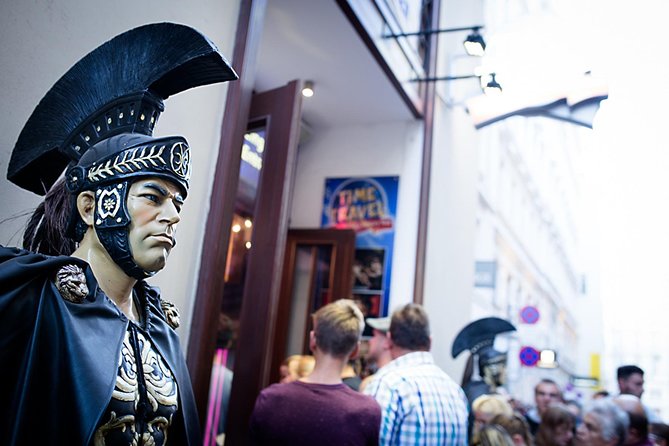
Time Travel Vienna is located in the Michaelerkloster, a historic complex near the heart of Vienna. The setting matters. You are not watching a history film in an ordinary cinema. You are moving through old vaults while modern equipment brings different chapters of Vienna to life.
The experience is guided in German, with audio translation available through headphones. If you select English, the German presentation is translated at the same time. That arrangement is practical, but it does mean you should pay attention to your headset. In a noisy group, children talking or nearby sound effects can make the translation harder to follow.
The group size is limited to a maximum of 32 people. That is large enough to feel like a proper tour, but small enough to keep the experience manageable. The show is guided rather than a free-form museum visit, so you move from one presentation to the next with the group.
Plan on about one hour. Some people find the full visit closer to an hour and a half, depending on the pace and transitions. It is still a compact activity, useful when you want a history introduction without giving up half a day.
More Attraction Tickets in Vienna
- Vienna: Classic Ensemble Vienna in St. Peter’s Church Ticket
★ 4.7 · 4,819 reviews - Vienna Kunsthistorisches Museum Day Admission Ticket
★ 4.6 · 3,690 reviews - Vienna: Tickets for Mozarthaus Vienna with Audio Guide
★ 4.2 · 2,344 reviews
Roman Vindobona: Vienna before the palaces
The first major stop reaches back to Roman times, when Vienna was known as Vindobona. The presentation gives you a quick look at the city’s early role and helps explain that Vienna did not begin with the Habsburgs or the grand imperial buildings you see today.
This part works best as an introduction. You should not expect a detailed archaeological lesson. Instead, the technology gives you a visual sense of the Roman settlement and places Vienna’s later story on a much longer timeline.
That quick overview can be useful if you are new to Vienna. After the show, the city’s layers make more sense. A street, church, or old foundation is easier to appreciate when you remember that Vienna has been shaped by Roman settlement, medieval disease, imperial rule, music, war, and reconstruction.
The plague pit and medieval Vienna
The show then shifts to the medieval city and the plague. This is one of the darker sections, and it gives the experience some emotional range. Vienna’s past is not presented only as palaces, waltzes, and famous composers.
The plague section uses special effects to suggest what life was like during an outbreak. It is theatrical rather than graphic in a museum sense, but younger children or more sensitive visitors may find it unsettling. One family with a teenager found the experience enjoyable partly because the scary moments were manageable, but reactions will vary.
I appreciate this stop because it keeps the story honest. Vienna’s beauty came with hardship, overcrowding, disease, and fear. The show presents those subjects quickly, so you will not leave with a detailed account of medieval medicine or public health. You will, however, remember that the city’s past was not all imperial ceremony.
Habsburg rulers and the imperial city
The Habsburg section is likely to be familiar if you have already visited Schönbrunn Palace, the Hofburg, or the Imperial Treasury. Here, the show gives you a brisk look at the people and power behind Vienna’s grand architecture.
Wax figures, robotics, projected images, and short presentations help put faces to the imperial story. This is a good way to introduce children to the Habsburgs before visiting an actual palace. Instead of asking a child to absorb a long list of rulers and dates, the show turns the subject into a series of visual scenes.
Adults should keep their expectations in check. You will get broad facts rather than political detail, family disputes, or a close look at how the empire worked. The presentation is designed to entertain first and explain second.
Still, that approach has value. If the show gives you enough interest to visit a palace afterward, it has done its job. It can also help you decide which imperial attractions deserve your limited time.
More historical tours:
- Vienna: Time Travel and Magic Vienna History Tour
★ 4.6 · 3,879 reviews - Vienna: World War II Historical Walking Tour
★ 4.8 · 1,772 reviews - Vienna Historic Center Small Group Walking Tour
★ 5.0 · 1,746 reviews - Skip-the-Line Schonbrunn Palace Guided Tour and Vienna Historical City Tour
★ 3.5 · 940 reviews
Mozart, Strauss, and Vienna’s musical past
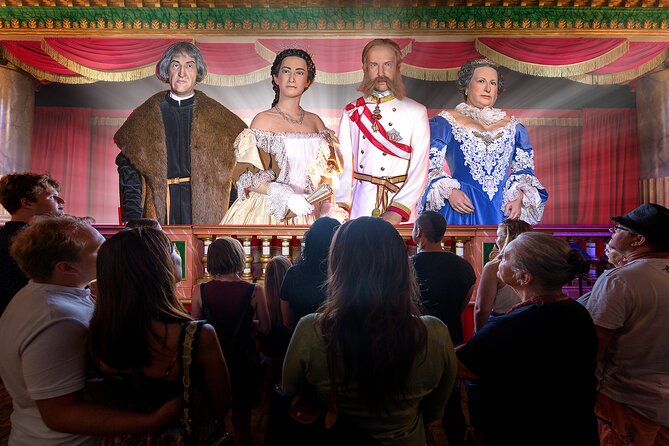
Vienna’s musical identity receives its own lively section. You meet famous figures such as Mozart and Johann Strauss, with the presentation using movement, sound, and visual effects to connect them to the city.
The spinning waltz car is one of the most memorable parts for many people. It offers a simple simulated ride through Vienna’s musical heritage, giving you a sense of the city as a place of performance and dance.
This is not a replacement for a concert or a visit connected to Mozart’s life. It is a short, entertaining primer. If you know little about Vienna’s composers, you will come away with a clearer idea of why music is so closely tied to the city. If you already know the subject well, you may find this section light.
The best part is the change of pace. After Roman history, plague, and emperors, the musical segment keeps the show from feeling like a string of lectures.
The air raid shelter and postwar Austria
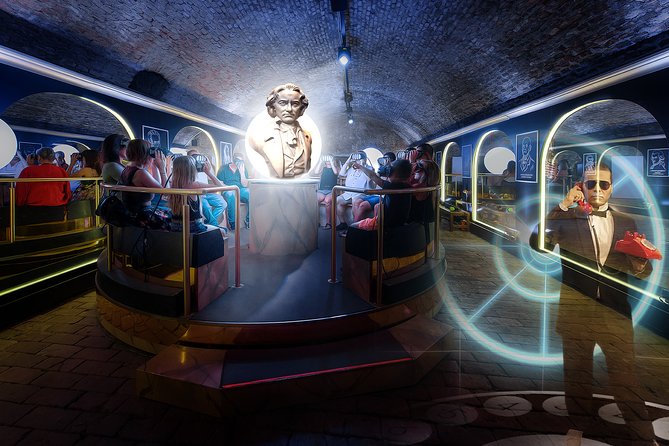
The World War II section takes you into an original air raid shelter. This is one of the more serious moments in the experience, and it can leave a stronger impression than the lighter ride sections.
The simulated air raid is designed to give you a sense of the danger and tension of the period. It does not provide a full account of Vienna during the war, and one criticism is that the show could cover more of the Second World War. That is a fair point. The section is short, and anyone seeking a detailed treatment of Austria’s wartime history will need another museum or tour.
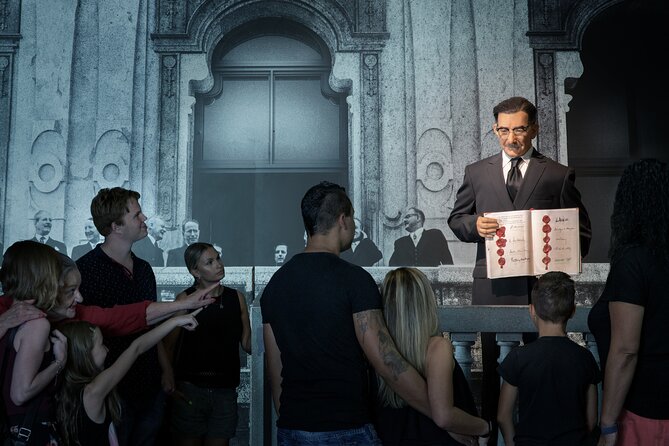
The story then moves toward postwar Austria, including Leopold Figl’s famous declaration that Austria is free. This helps connect the destruction of the war with the country’s return to independence.
I value the contrast here. The experience can be funny and playful in one room, then thoughtful and sobering in the next. That range gives the hour more weight than a simple tourist ride.
The virtual fiaker ride back to today
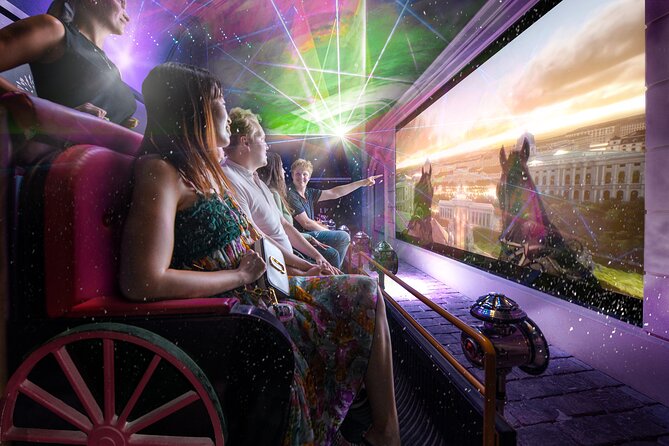
Near the end, a magical carriage ride takes you back toward modern Vienna. The virtual fiaker experience offers views of major landmarks as you travel through the city without physically walking its streets.
It is a clever way to finish. You get a broad visual orientation before stepping outside to see the real buildings. If this is your first day in Vienna, the ride may help you recognize the city center and choose what to visit next.
Do not treat it as a substitute for walking. A virtual view cannot give you the scale, detail, or atmosphere of Vienna’s streets. Its value is that it lets you see several landmarks quickly, including places you may not have time to visit during a short stay.
This final section also helps younger visitors stay engaged. The show keeps changing its format, so there is less chance of a child feeling stuck in one long historical display.
Why the special effects work, and where they fall short
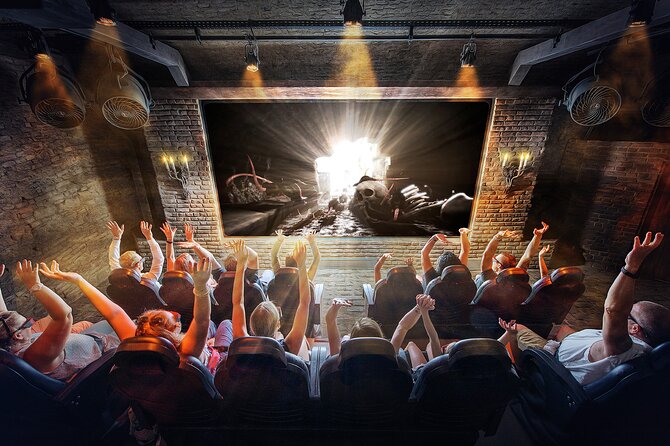
The show’s main strength is variety. You are not asked to stand still and listen for an hour. One section may use animatronics, another video, another a simulated ride, and another virtual reality goggles. That constant change is a major reason families tend to enjoy it.
The 5D or 4D cinema presentation is especially popular. Motion, sound, and physical effects help create a sense of being present in another period. The virtual reality section adds another memorable layer, particularly for children and teens.
At the same time, the effects can sometimes overpower the history. The story is simplified so that the technology remains easy to follow. If you want careful dates, competing interpretations, or a detailed explanation of Austria’s political past, this is not the right main attraction.
I would think of it as a lively orientation show. It gives you names, periods, and images to carry into the rest of your sightseeing. It does not attempt to answer every question.
Is $27.76 a good value?
At about $27.76 per person, this is not the cheapest indoor activity in Vienna. The value depends on what you want from it.
For a family, the price can make sense because the experience combines history and entertainment in one visit. You get roughly an hour of guided presentations, multiple technology-based scenes, audio support, and a central location. It can also be a useful break from museums, churches, and palace rooms.
For an adult who already knows Vienna well, the value is less certain. You may find the history too brief or the tone too light. A traditional museum could offer more detail for a similar amount of time, though it would not provide the same rides and effects.
The strongest value comes when you use it as a first or second activity in Vienna. Afterward, you can visit the real places introduced in the show. The experience is also a sensible choice on a rainy day or when your group needs something that works for different ages.
The tour is booked around 10 days ahead on average, so popular times can fill. A mobile ticket makes entry simple, but keep your booking details available when you arrive.
Who should book Time Travel Vienna?
I would recommend it most strongly to families with school-age children and teens. The format makes history easier to grasp, and the shorter running time helps hold attention. Children can enjoy the technology while adults pick up a useful outline of Vienna’s past.
It also suits first-time visitors who want a fast introduction. If you are in Vienna for only a few days, the show can help you decide which historical figures, buildings, and periods deserve more time.
Couples and solo visitors should consider their own taste. If you enjoy playful attractions and do not mind a simplified presentation, you may have a good time. If you prefer quiet museums, original objects, and long-form historical explanation, you may find it underwhelming.
The show is available with German live commentary and audio translation in ten languages. English is included, along with Spanish, Italian, French, Japanese, Chinese, Russian, Hungarian, Polish, and Czech. Animals are not allowed inside.
If you need to change your booking, handle it carefully. Free cancellation is available up to 24 hours before the start time, with a full refund. Changes made within 24 hours are not accepted, and a time change made through a booking platform may not always reach the venue correctly. Check that the new time has been confirmed directly before you arrive.
My recommendation: book it for fun, not scholarly detail
Book Time Travel Vienna if you want a family-friendly, indoor introduction to the city with plenty of movement and technology. The 5D cinema, virtual reality, musical ride, air raid shelter, and virtual carriage keep the hour lively, while the broad historical story gives you useful context.
Skip it if you want a serious account of Austria’s wars, politics, or imperial system. The show is intentionally simple, and its greatest success is making history approachable rather than complete.
For most first-time visitors with children, I think it is worth the price. Go early in your stay, use it to get your bearings, and then follow up by seeing the real Vienna on foot.
FAQ
How long does Time Travel Vienna last?
The experience lasts approximately one hour. Some visits may take closer to an hour and a half, depending on the pace and transitions.
What language is the tour offered in?
The guided presentation is in German, with audio translation available in English, Spanish, Italian, French, Japanese, Chinese, Russian, Hungarian, Polish, and Czech.
Is admission included with the ticket?
Yes. Admission to Time Travel: The Vienna History Show is included.
Does the experience use virtual reality?
Yes. The show includes virtual reality, a 5D cinema, animatronics, visual effects, robotics, wax figures, and simulated ride experiences.
Is Time Travel Vienna suitable for children?
Yes. The interactive format is designed to work well for families and children. Some sections, including the plague and air raid scenes, may feel intense for sensitive children.
How many people can join the tour?
The activity has a maximum group size of 32 people.
Can I cancel for a full refund?
You can cancel for a full refund at least 24 hours before the experience start time. Cancellations within 24 hours are not refunded, and changes made within 24 hours are not accepted.
Just added around Vienna
- Mobile puzzle rally tour at the Vienna Central Cemetery★ 4.5 · 3 reviews
- RAXI (E-Rickschaw) big private Vienna tour★ 4.5 · 3 reviews
- 8 days European Highlights PRIVATE TOUR from Budapest including Budapest Vienna Prague and Bratislava★ 5.0 · 3 reviews
- Private Transfer from Vienna to Prague with 1 hour Stop in Kutna Hora★ 4.5 · 3 reviews
- Palais Lobkowitz Audio Guide Tour★ 4.0 · 3 reviews
- Private Tour from Vienna to Melk and Dürnstein★ 4.5 · 3 reviews
- Vienna: Designer Fashion Time Capsule Experience★ 5.0 · 3 reviews
- Private day trip from Munich to Eagle’s Nest & Hallstatt★ 4.7 · 3 reviews
Historical Tours, compared.


Vienna Historic Center Small Group Walking Tour
Read our review →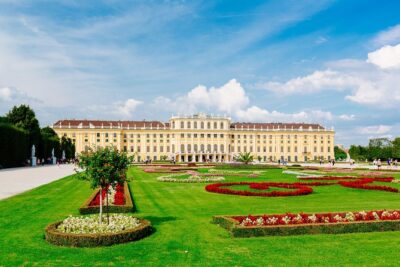
Skip-the-Line Schonbrunn Palace Guided Tour and Vienna Historical City Tour
Read our review →
Vienna Mozart Concert in Historical Costumes at the Musikverein
Read our review →
Browse the lists this tour appears in