
Reviewed · CYCLING TOURS
Vienna Highlights Small-Group Bike Tour
Vienna is easier on two wheels. I like that this three-hour ride links grand Habsburg landmarks with the Prater and Danube Canal, giving you a much broader look than a walking tour. The mostly flat route and good-quality bikes also make the 10-kilometer ride manageable for many riders.
I also like the guides’ mix of history, humor, and local perspective. Names praised in the feedback include Robert, Marco, Ava, Karl, Clemens, Jan, and Horst. The main concern is group size: a ride advertised for no more than 15 people can feel crowded at traffic lights, and a few riders found it hard to hear or keep up.
If you have only a short time in Vienna, this is a useful way to get your bearings fast. Just know that the tour favors safer roads and bike paths over a close look at every lane of the old city center.
In This Review
- Key points about the Vienna bike tour
- Why Vienna works well by bike
- Starting on Franz-Josefs-Kai
- Riding the Ringstrasse past Vienna’s grandest buildings
- Heroes’ Square and Vienna’s difficult past
- Hundertwasserhaus and the Lanstrasse neighborhood
- Prater and the Riesenrad Ferris wheel
- The Danube Canal, street art, and open-air riding
- Pace, traffic, and group size
- The guides make the difference
- Is $56.86 good value?
- Who should book this ride?
- Should you book the Vienna Highlights Small-Group Bike Tour?
- FAQ
- How long is the Vienna Highlights Small-Group Bike Tour?
- How far do you cycle?
- Where does the tour start?
- Where does the tour end?
- What language is the tour offered in?
- Is bicycle use included?
- Does the tour include food or drinks?
- What happens if the weather is bad?
Key points about the Vienna bike tour
- A 10-kilometer route in about three hours: You cover a wide slice of Vienna without spending the day in the saddle.
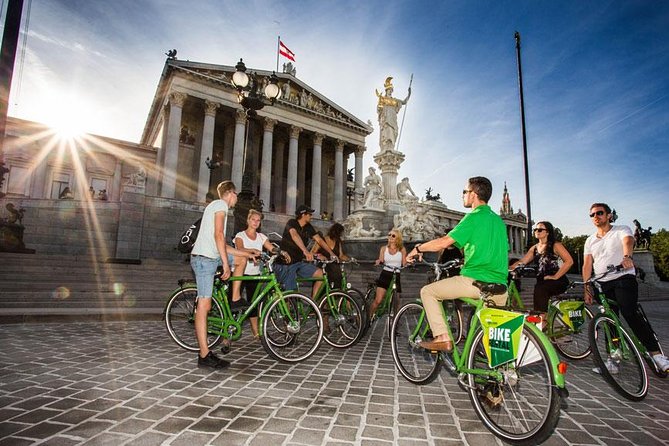
- Ringstrasse architecture: See City Hall, Parliament, Vienna University, the Hofburg area, and the Vienna Opera House from the road.
- Prater and the Riesenrad: The route reaches Vienna’s famous amusement park and its giant Ferris wheel.
- Danube Canal riding: Expect a pleasant stretch beside the water, with time to notice the canal’s street art.
- Flat, easy-paced cycling: The route is suitable for many ordinary bike riders, though cobbles and city traffic still require care.
- A small-group format with a caveat: The maximum is listed as 15 people, but larger groups may feel less intimate at junctions.
Why Vienna works well by bike
Vienna can look compact on a map, yet its major sights spread across a wide area. The opera house, Ringstrasse, Prater, Danube Canal, Hundertwasserhaus, and Heroes’ Square are not all next door to one another.
On foot, you would need to choose between a close look at the central monuments and a longer outing toward the Prater. By bike, you can connect both areas in one ride. That is the chief value here. You are not simply pedaling in circles around the old town. You get a quick sense of how Vienna’s imperial center connects with its parks, waterways, and outer neighborhoods.
The route covers about six miles, or 10 kilometers. That is not a demanding distance for a regular cyclist, especially because Vienna is mostly flat and the pace is described as relaxed. Still, three hours is a real chunk of time. If you rarely ride a bike, or if you dislike stopping and starting in traffic, you should take the physical requirement seriously.
The bikes and helmets receive strong praise, and the tour includes bicycle use and a professional guide. You do not have to work out rental paperwork, plan a route, or worry about missing the key sights. That convenience is worth something in a city where unfamiliar streets, tram tracks, traffic lights, and one-way roads can make solo riding less carefree.
More bike tours:
- Classic Vienna: 3-Hour Guided Bike Tour
★ 4.7 · 1,846 reviews - Wachau Valley Wine Tasting Bike Tour from Vienna
★ 5.0 · 829 reviews - Vienna City Bike Tour
★ 4.5 · 599 reviews
Starting on Franz-Josefs-Kai
The tour begins at Vienna Explorer on Franz-Josefs-Kai 45 in the 1010 district. This is a central meeting point near public transportation, and the tour returns there at the end.
You meet the guide, receive your bicycle, and go through a short safety overview before setting out. Since the group may include riders with different levels of experience, listen closely to the instructions and make sure you are comfortable with the bike before leaving.
The safety briefing is intended to be part of the experience, but one piece of feedback specifically found it insufficient. That is useful advice for you: ask about road crossings, staying together, and what to do if a traffic light separates the group. The guide generally waits for slower riders, but you should not assume every junction will feel effortless.
Riding the Ringstrasse past Vienna’s grandest buildings
The Ringstrasse is the natural opening act. This broad boulevard traces the edge of Vienna’s historic center and presents a concentrated display of imperial-era architecture.
You pass the Neo-Classical Vienna Opera House, then continue toward City Hall, Vienna University, the Houses of Parliament, and the Hofburg area. These buildings are best understood as pieces of a larger plan. The Ringstrasse was created to display Vienna’s political and cultural importance, and each major building uses a different historical style to make its point.
The Vienna Opera House gets about 20 minutes as a named stop. You will admire the exterior rather than attend a performance, so this is a photo and orientation stop, not an interior visit.
City Hall, or Rathaus, is another planned stop of about 20 minutes. Its Neo-Gothic design gives it a very different look from the Opera House. The route also passes Vienna University and Parliament, giving you a useful architectural comparison without requiring a long walk between sites.
This section is particularly good for first-time visitors. A guide can explain what you are seeing while you remain mobile, rather than leaving you to identify buildings from a map. The tradeoff is that a moving tour cannot offer the same close architectural study as a dedicated walking tour.
Heroes’ Square and Vienna’s difficult past
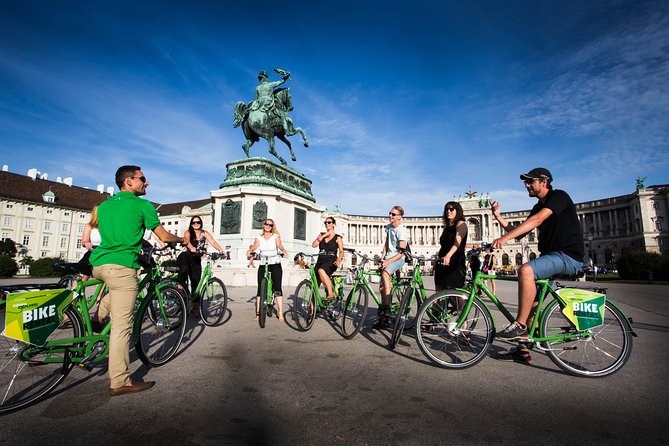
The route continues through Heroes’ Square, or Heldenplatz, a major open space beside the Hofburg. It is associated with Austria’s imperial story and also with one of the darkest political moments in Vienna’s modern past.
Adolf Hitler delivered his 1938 annexation speech there after Nazi Germany absorbed Austria. The stop gives the guide a chance to connect the place with the political history of the city, rather than presenting it only as a grand ceremonial square.
This is one of the more meaningful pauses on the route. The tour does not treat Vienna as a collection of pretty façades alone. You get reminders that these impressive public spaces have been used for propaganda, power, and political theater.
You should expect a short explanation rather than a full museum visit. If you want a detailed study of Austria under Nazism, you will need to set aside time for a separate museum or memorial.
A few more trips of this kind worth comparing:
- Vienna: Vivaldi’s Four Seasons Concert in Karlskirche
★ 4.7 · 14,951 reviews - Vienna: Spanish Riding School Training
★ 3.9 · 9,281 reviews - Vienna: Skip-the-cashier-desk-line Giant Ferris Wheel Ride
★ 4.5 · 7,859 reviews - Vienna: Schönbrunn Palace & Gardens Skip-the-Line Tour
★ 4.7 · 7,739 reviews
Hundertwasserhaus and the Lanstrasse neighborhood
The ride then shifts from imperial Vienna to the more playful Hundertwasserhaus. Located in the Vorstadt Lanstrasse area, this apartment complex was designed by Friedensreich Hundertwasser, a radical Viennese artist and designer.
Its uneven lines and bright colors make it an easy contrast with the formal buildings along the Ringstrasse. This is a photo stop of about 20 minutes, and it gives the tour welcome visual variety.
The building is interesting not only because it looks unusual, but because it shows another side of Vienna’s design culture. After seeing monumental public buildings designed to project order and authority, you encounter architecture that celebrates irregularity.
Do not expect a full art lecture or access to private apartment interiors. The value is in seeing the building in context and understanding how strongly it differs from the city’s imperial core.
Prater and the Riesenrad Ferris wheel
One of the tour’s best features is the ride to the Prater amusement park. Many short city tours stay tightly inside the old center, but this route makes the effort to reach one of Vienna’s most recognizable recreational areas.
The main photo stop is the Riesenrad, the giant Ferris wheel that has become one of the city’s most familiar skyline markers. You will see it from the park area and have time to stop for pictures.
The Prater changes the mood of the tour. Vienna is not only palaces, ministries, and formal squares. This is a place for leisure and amusement, and the bike ride lets you see that broader side of the city.
The stop is also a good example of why cycling beats walking for this particular plan. Reaching the Prater on foot from the central monuments would take time and energy. By bike, it becomes a natural part of the circuit.
The limitation is that the tour does not include rides or admission to attractions. The Riesenrad is a landmark stop, not a Ferris wheel experience. If you want to ride it, plan a separate visit.
The Danube Canal, street art, and open-air riding
After the Prater, the route includes a pleasant stretch along the Danube and Danube Canal. The canal section is especially appealing because it offers a change from monumental architecture.
You may notice street art along the water and get a more contemporary view of Vienna. The canal also gives the group a chance to ride in a less formal setting after the traffic and buildings of the Ringstrasse.
The description refers to sections along the blue waters of the Danube, while the detailed stops specify the Danube Canal. You should think of this as a water-side portion of the route rather than a long excursion into the wider Danube region.
This part of the ride is valuable for atmosphere. It is less about checking off a famous building and more about seeing how Vienna’s public spaces shift from ceremonial boulevards to recreational paths.
Pace, traffic, and group size
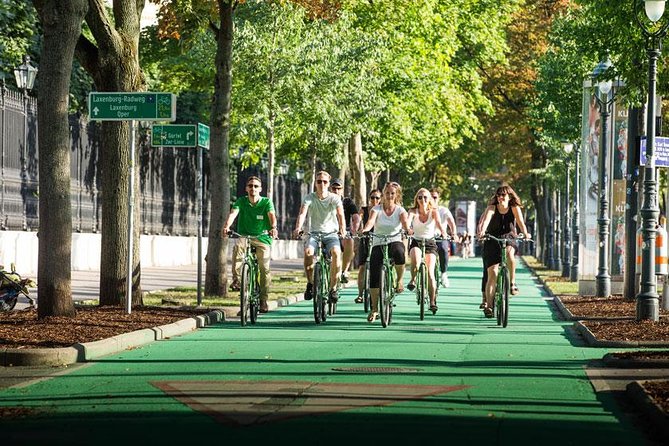
The route is described as easy cycling, and several riders found the pace comfortable even without a high level of fitness. Vienna’s flat terrain helps. The guides also receive repeated praise for waiting for slower riders and keeping the outing friendly.
That does not mean the ride is completely effortless. One rider found the three-hour duration longer than expected, and another pointed out that cobbled streets can be uncomfortable. If you are sensitive to jolts, wear supportive clothing and expect some uneven surfaces.
City riding also brings traffic lights and road crossings. In a larger group, the front and rear can become separated when the signal changes. Guides are expected to wait, but you may miss part of the commentary if you are at the back.
The maximum group size is listed as 15 people, which is reasonable for a public bike tour but not truly intimate. Some feedback described the group as larger than expected and suggested that 10 or fewer would make crossings and explanations easier.
This is the most important practical drawback. If you want constant access to the guide and a quiet, flexible ride, a private tour would suit you better. If you accept a group format in exchange for a lower price, the arrangement is more workable.
The guides make the difference
The strongest part of the experience is the guiding. Ava is praised for clear English and enthusiasm for her home city. Robert receives repeated approval for his historical explanations, patience, and sense of humor.
Marco is described as funny and good at bringing the past to life. Karl is praised for setting a comfortable pace, while Clemens, Jan, and Horst also receive warm comments for their energy and local knowledge.
The names matter because the guide shapes the tour more than the route does. The same Ringstrasse buildings can feel like a dry list of façades or a lively story about power, art, and city life.
The English-language format is useful if you want steady explanations throughout the ride. The guide does not simply point out the Opera House and City Hall. The best version of this tour adds context, personal observations, and humor along the way.
There is some variation in style. One rider found the guide less engaging and wanted more unusual stories. That is a fair warning. The tour is strongest when your guide tells stories with personality, but you should not expect the same performance from every guide.
Is $56.86 good value?
At $56.86 per person, this is not the cheapest way to move around Vienna. You could use public transportation for less, and walking costs nothing beyond your time.
The comparison is not really fair, though. The price includes a bicycle, a helmet, route planning, and a guide who connects sights that are spread across the city. You are paying to cover about 10 kilometers while receiving a running introduction to Vienna’s architecture and past.
I think the value is good if you have only a day or two in the city. The ride can help you decide which places deserve a longer return visit. You see the Opera House, Ringstrasse, Heroes’ Square, Hundertwasserhaus, Prater, and the canal without spending several hours planning connections.
The value is weaker if you want deep access to individual attractions. No interior admissions, food, or drinks are included. Hotel pickup and drop-off are also not included, though the central meeting point is near public transportation.
Who should book this ride?
I would recommend it to first-time visitors who want a broad orientation, people with limited time, and riders who prefer an active introduction to a city. It also suits you if you like mixing famous sights with less formal stops such as the Prater and canal street art.
Families can consider it, but children 10 and under may not enjoy three hours of cycling and historical commentary unless they already like both. The route is not presented as a children’s entertainment tour.
You should also have moderate physical fitness and be able to ride a bicycle confidently. The terrain is mostly flat, but traffic, stop-and-go riding, and cobbles still demand attention.
The tour operates in all weather conditions. Dress for the forecast and understand that rain alone may not lead to cancellation. The cancellation terms allow a full refund when you cancel at least 24 hours before the start, but changes or cancellations inside that window are not refunded.
Should you book the Vienna Highlights Small-Group Bike Tour?
Book it if you want to see a lot of Vienna in three hours and are happy with an overview rather than long visits inside monuments. The combination of Ringstrasse architecture, Heroes’ Square, Hundertwasserhaus, Prater, and the Danube Canal gives you a broader picture than a central walking tour.
Skip it if crowded junctions, cobblestones, uncertain weather, or three hours on a bike sound unpleasant. You may also prefer another format if your main goal is the old city center, since the route deliberately uses safer roads and does not focus on every central lane.
For most capable riders on a short Vienna visit, the tour offers solid value. Arrive ready to ride, ask questions during the safety briefing, stay alert at crossings, and sit near the guide if hearing every explanation matters to you.
FAQ
How long is the Vienna Highlights Small-Group Bike Tour?
The tour lasts approximately three hours.
How far do you cycle?
The total cycling distance is approximately 10 kilometers, or six miles.
Where does the tour start?
It starts at Vienna Explorer, Franz-Josefs-Kai 45, 1010 Vienna, Austria.
Where does the tour end?
The tour ends back at the original meeting point.
What language is the tour offered in?
The tour is offered in English.
Is bicycle use included?
Yes. Use of the bicycle is included, along with a professional guide.
Does the tour include food or drinks?
No. Food and drinks are not included.
What happens if the weather is bad?
The tour operates in all weather conditions, so you should dress appropriately. A full refund is available if you cancel at least 24 hours before the experience start time.
Just added around Vienna
- Mobile puzzle rally tour at the Vienna Central Cemetery★ 4.5 · 3 reviews
- RAXI (E-Rickschaw) big private Vienna tour★ 4.5 · 3 reviews
- 8 days European Highlights PRIVATE TOUR from Budapest including Budapest Vienna Prague and Bratislava★ 5.0 · 3 reviews
- Private Transfer from Vienna to Prague with 1 hour Stop in Kutna Hora★ 4.5 · 3 reviews
- Palais Lobkowitz Audio Guide Tour★ 4.0 · 3 reviews
- Private Tour from Vienna to Melk and Dürnstein★ 4.5 · 3 reviews
- Vienna: Designer Fashion Time Capsule Experience★ 5.0 · 3 reviews
- Private day trip from Munich to Eagle’s Nest & Hallstatt★ 4.7 · 3 reviews
Cycling Tours, compared.
Wachau Valley Wine Tasting Bike Tour from Vienna
Read our review →
Grape Grazing: Wachau Valley Winery Biking Tour
Read our review →
Vienna by Bike 3-Hour All-In-One City Bike Tour in English
Read our review →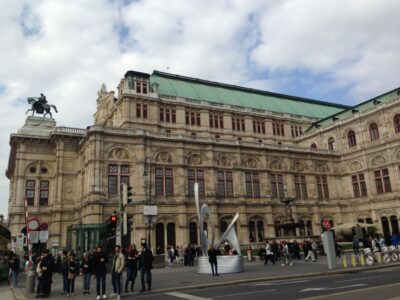
Browse the lists this tour appears in