
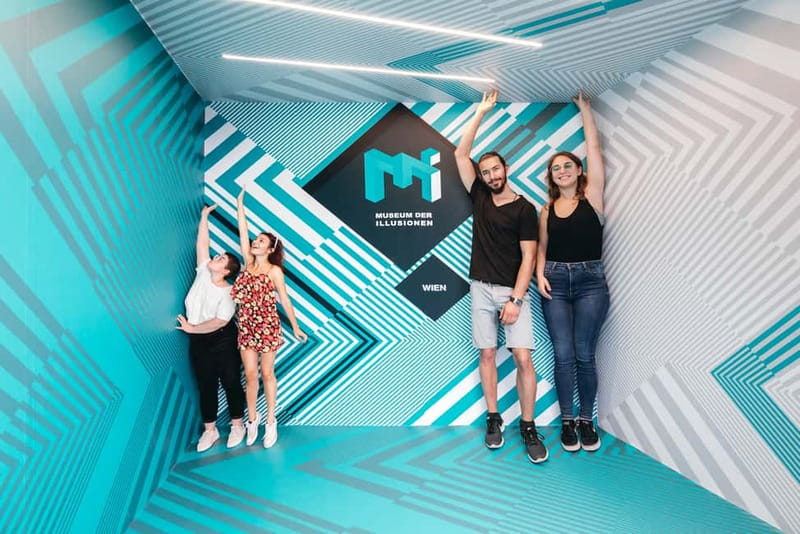
Reviewed · MUSEUMS
Vienna: Museum of Illusions Vienna Admission Ticket
Prepare to question your eyes. Vienna’s Museum of Illusions turns simple rooms, puzzles, and camera tricks into a playful hour of family entertainment. I like the mix of hands-on brain teasers and unusual photo opportunities, especially the Infinity Room and the rooms that make people appear to change size.
I also like that you can visit at your own pace, without committing to a long tour or a full afternoon indoors. The family-friendly format works well after Vienna’s grand museums and palaces. The main drawback is size: some people find the experience fun but shorter than expected, with fewer rooms than they hoped for.
In This Review
- Key points to know before you go
- What kind of museum is this?
- Starting with the 70-plus exhibits
- The Ames room and the strange business of size
- Losing your footing in the vortex tunnel
- Defying gravity in the inclined room
- The Infinity Room and your camera
- Wooden games for a different kind of challenge
- How long the visit may feel
- Who gets the best value from $18?
- A useful break from Vienna’s grand sights
- Booking, flexibility, and access
- Should you book the Museum of Illusions?
- FAQ
- How much does admission to the Museum of Illusions Vienna cost?
- What does the ticket include?
- How many exhibits are at the museum?
- Is the Museum of Illusions suitable for children?
- Is the museum wheelchair accessible?
- Can I cancel my booking for a refund?
- Can I reserve now and pay later?
Key points to know before you go

- More than 70 exhibits give you a varied set of visual tricks, puzzles, and interactive displays.
- The Infinity Room offers one of the best chances for unusual perspective photos, so bring a charged phone.
- The Ames room uses perspective to make people appear much larger or smaller than they really are.
- The vortex tunnel creates the feeling that the floor is moving, even though you are walking through a fixed installation.
- An inclined room plays with your sense of gravity and balance.
- The $18 admission is reasonable for a compact, playful stop, but less appealing if you expect a large traditional museum.
What kind of museum is this?
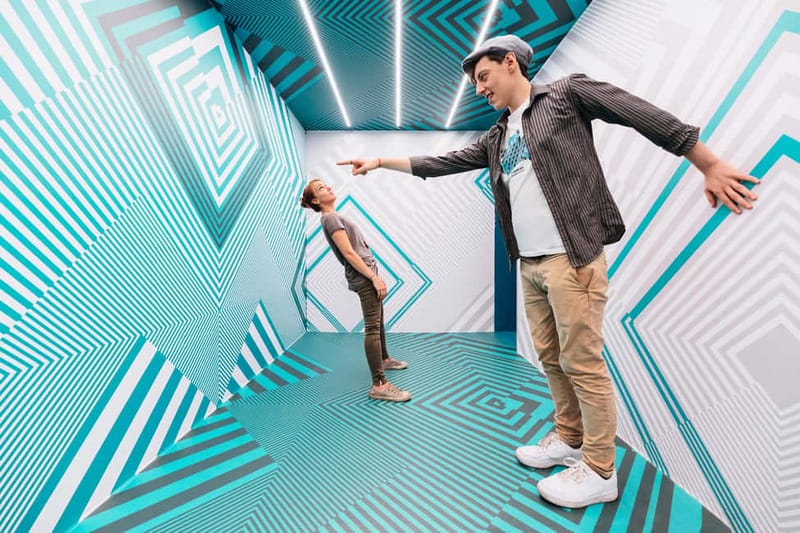
This is not a quiet collection of paintings, sculptures, or historical objects. The Museum of Illusions is an interactive attraction built around perception, balance, scale, light, and visual confusion.
You do not simply look at displays. You try things, pose for photographs, solve wooden puzzles, and watch your brain make quick assumptions that turn out to be wrong. That makes the experience especially easy to share with children, friends, and family members who may not enjoy conventional museums.
The attraction is suitable for all ages. Younger children can react to the physical tricks, while older children and adults may spend more time figuring out why an illusion works. I like that it gives everyone a reason to take part rather than leaving one person to read labels while the rest of the group waits.
The admission is for the museum itself, and the experience is valid for one day. You should check availability for the starting times when booking, since the ticket information does not provide one universal schedule.
More Attraction Tickets in Vienna
- Vienna: Classic Ensemble Vienna in St. Peter’s Church Ticket
★ 4.7 · 4,819 reviews - Vienna Kunsthistorisches Museum Day Admission Ticket
★ 4.6 · 3,690 reviews - Vienna: Tickets for Mozarthaus Vienna with Audio Guide
★ 4.2 · 2,344 reviews
Starting with the 70-plus exhibits
The museum includes more than 70 exhibition pieces, giving you a steady collection of small experiments rather than one single headline attraction. Some displays challenge your eyes, some test your balance, and others ask you to think through a puzzle in a different way.
That variety matters. If one illusion does not work for you, the next one probably will. You might enjoy the physical rooms, while someone else in your group prefers the wooden games. The attraction works best when you slow down enough to try each exhibit instead of rushing from one photo spot to the next.
The displays also offer a useful reminder that seeing is not always the same as understanding. Lines, angles, scale, and movement can all influence what your mind thinks is happening. The educational value is informal, but real. You learn by standing in the wrong place, looking again, and testing the effect for yourself.
Because the exhibits are interactive, the pace depends on your group. A family with small children may stop at nearly every display. A group of adults looking mainly for photographs may move faster. The available information does not give a fixed visit length, so plan it as a flexible indoor stop rather than a precisely timed attraction.
The Ames room and the strange business of size
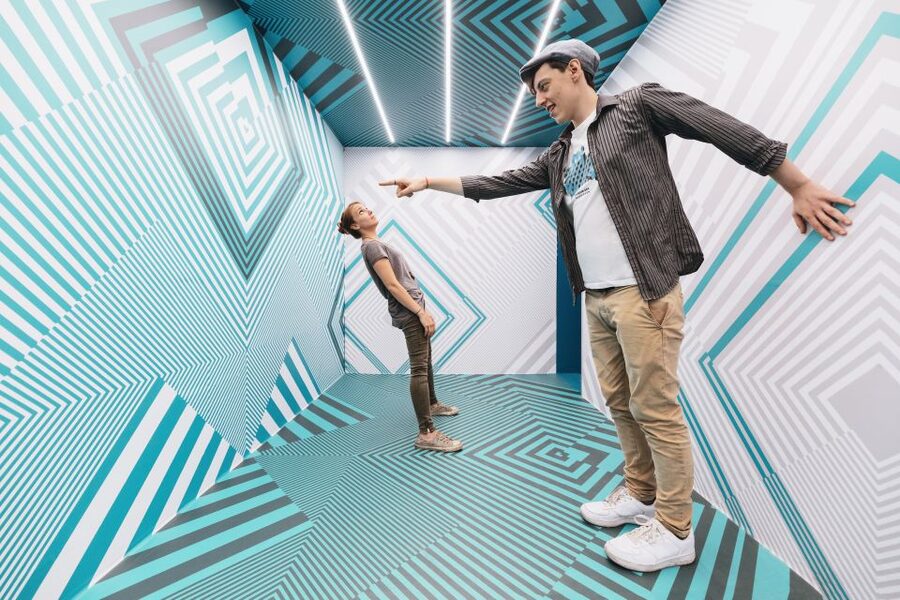
The Ames room is one of the clearest examples of how perspective can fool you. Its design makes people positioned in different parts of the room appear dramatically different in size, even though the effect comes from the room’s shape and your viewing angle.
This is a strong group exhibit because it needs more than one person to show its full effect. You can take turns standing in different positions and compare the results. It is also a good example of why the museum works better with friends or family than as a quick solo visit.
The room is more than a silly photograph. It shows how strongly your brain depends on familiar shapes and spaces. Your eyes recognize a room, but the room has been built to disrupt the clues your brain normally uses.
Bring patience here. The best image may require you to stand in a particular spot and frame the photograph carefully. The attraction is designed for experimentation, so do not worry about getting the perfect picture on the first try.
Losing your footing in the vortex tunnel
The vortex tunnel creates the sensation that the ground beneath you is moving. The tunnel itself is a visual and physical challenge, and your balance can feel uncertain even when the walkway is stable.
This is one of the more memorable stops for people who enjoy movement-based illusions. It gives you something to feel, not just something to look at. You may find yourself concentrating on each step while your eyes insist that the surroundings are rotating or shifting.
If you are sensitive to motion or prefer not to use an exhibit that affects your balance, you can simply take your time and decide how much you want to participate. The experience is family-friendly, but that does not mean every person will enjoy every physical illusion equally.
The tunnel also helps break up the quieter puzzle stations. After studying wooden games or optical displays, you get a more active challenge. That change of pace keeps the visit from feeling like a room full of similar posters.
More museums:
- Vienna: Skip-the-Line Sisi Museum, Hofburg and Gardens Tour
★ 4.8 · 5,918 reviews - Tickets for the Albertina Exhibitions
★ 4.7 · 2,126 reviews - Vienna: Chocolate Workshop in Chocolate Museum w/ Tasting
★ 4.5 · 1,802 reviews - Sigmund Freud Museum Ticket
★ 4.6 · 1,668 reviews
Defying gravity in the inclined room
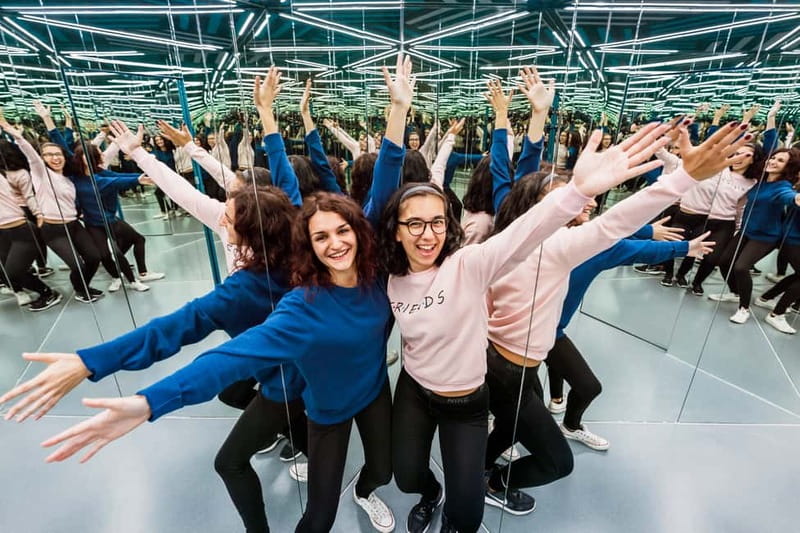
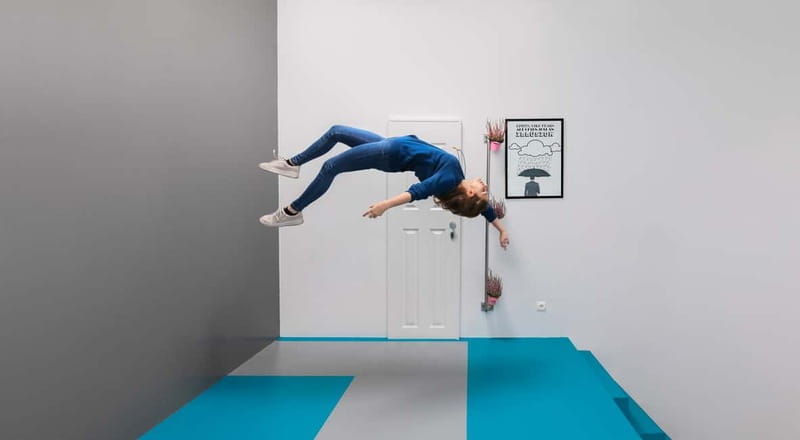
The inclined room plays with your sense of level and balance. A room that appears ordinary can make your body feel as if it is standing at an angle, creating a simple but effective challenge to your internal sense of gravity.
This is the kind of exhibit that works best when you enter with an open mind. Your eyes try to tell you how the room should feel, while your body gives you a different message. The result can produce funny photographs, but the real appeal is the brief confusion.
I like this part of the museum because it does not require a technical explanation before you enjoy it. You can feel the effect first, then think about how the room has altered your expectations. That makes the attraction accessible to children and adults alike.
As with the vortex tunnel, use care if you are uncomfortable with balance-based experiences. Wheelchair access is available at the museum, which is an important practical point for planning your visit. The supplied information does not describe the layout of every individual exhibit, so you may want to ask staff about specific displays if needed.
The Infinity Room and your camera
The Infinity Room is the obvious place to have your smartphone or camera ready. Its design creates unusual perspective photographs, giving the impression of repeated space and a much larger room than you are actually standing in.
You do not need professional equipment. A phone is enough, and the attraction specifically encourages you to capture the effects. If you are visiting with friends or children, take turns as photographer and subject so everyone gets a chance to appear inside the illusion.
Good photographs usually depend on position. Move slowly, look at the screen, and try more than one angle. A rushed snapshot may miss the effect, while a small adjustment can make the image much clearer.
The photo opportunities add value for groups who enjoy sharing pictures from a day in Vienna. They also make the attraction more social than a standard museum. Still, I would not book the ticket only for one photograph. The Infinity Room is part of a larger collection, and the visit is better when you treat it as an interactive experience with photos along the way.
Wooden games for a different kind of challenge
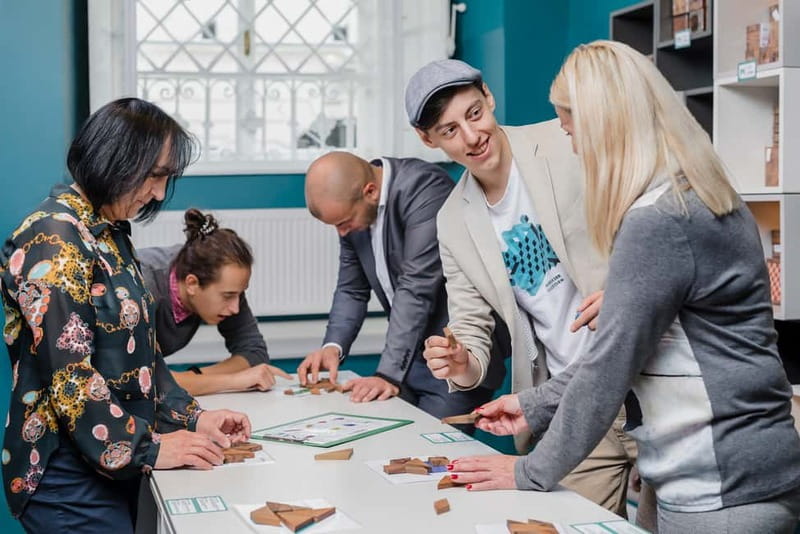
Not every exhibit relies on mirrors, strange rooms, or visual effects. The museum also includes tricky wooden games that ask you to solve problems and think creatively.
These puzzles provide a welcome change from taking photographs. You can work alone, compare solutions with friends, or let children try without immediately giving them the answer. The point is not speed. It is the pleasure of testing an idea, finding that it fails, and trying another approach.
I find this part particularly useful for mixed-age groups. One person may not care about posing in the Infinity Room but may spend extra time with a puzzle. Another may enjoy the physical rooms more. Having both kinds of exhibits helps the museum appeal beyond a single age group.
The games also reinforce the museum’s main idea: your first impression may not be correct. You have to change your method, not just repeat the same move.
How long the visit may feel
The ticket is valid for one day, but that does not mean you need to reserve a full day for the museum. The supplied details do not state a fixed duration, and the attraction is described by some as small and enjoyable rather than extensive.
That is both a strength and a limitation. I like the compact format because you can fit it between other Vienna plans. It can give you a break from historical sights without taking over your schedule. Families may appreciate a shorter indoor activity, especially when children have reached their limit for formal exhibits.
On the other hand, people expecting a large museum with many spacious galleries may feel the visit ends too soon. The number of displays is respectable, but the overall experience remains a light-hearted attraction rather than a major cultural institution.
Your pace will make a big difference. Try every puzzle, take several photographs, and allow time for the perspective rooms, and you will get more from the admission. Rush through for a handful of pictures, and the $18 price may feel less convincing.
Who gets the best value from $18?
At $18 per person, the ticket sits in the range of a modest paid attraction rather than a major day-long museum. I think it offers fair value for families and groups who will use the interactive displays, take photographs, and spend time with the games.
The price is easier to justify when several people in your group have different interests. Children can play, adults can take photos, and everyone can compare how the illusions affect their perception. The museum also gives you a change of pace from Vienna’s art, music, and imperial sights.
For a solo visitor who wants serious science or a large collection, the value is less clear. You may still enjoy the experiments, but the experience is built around participation and shared reactions. The attraction is also not the best choice if you want a quiet, traditional museum visit.
A practical way to judge the price is to ask how much you value a short, unusual activity. If you want an easy stop with plenty of photo chances, $18 is reasonable. If you want several hours of detailed exhibits, you may prefer to spend your budget elsewhere.
A useful break from Vienna’s grand sights
Vienna is full of palaces, historic rooms, classical art, and formal cultural attractions. Those are essential to the city, but they can also make a sightseeing day feel heavy, especially for children.
The Museum of Illusions gives you something completely different. You can move around, laugh at the odd results, and take part instead of standing quietly in front of objects. That contrast is one of the strongest reasons to include it in a family schedule.
I would also consider it for a rainy day or for a group with mixed energy levels. The activity offers an indoor change of pace without requiring specialist knowledge. You do not need to understand the science in advance to enjoy the effects.
The attraction is not a substitute for Vienna’s major museums. It is a small, playful addition that works best alongside them.
Booking, flexibility, and access
You can reserve now and pay later, which helps if your Vienna schedule is still changing. Free cancellation is available up to 24 hours in advance for a full refund, giving you some protection if your plans shift.
The ticket is valid for one day, and you should check the available starting times before confirming. Admission includes entry to the Museum of Illusions, with no other inclusions specified.
Wheelchair access is available. Since individual exhibit layouts are not described in the supplied information, you may want to check with the museum staff about particular displays if your group needs details beyond general access.
Should you book the Museum of Illusions?
Book it if you want a short, playful, interactive stop that works for children, adults, friends, and families. The Ames room, vortex tunnel, inclined room, Infinity Room, and wooden puzzles offer enough variety to keep the experience lively.
I would be more cautious if you expect a large museum, a long visit, or a serious cultural collection. Some people find the attraction smaller than hoped, even while enjoying the displays and helpful staff.
For most families and groups, the $18 ticket is a fair buy when you take photographs and try the exhibits at an unhurried pace. It is especially useful as a break from Vienna’s more formal sights. Check the starting time, bring your phone, and treat it as a compact hour or two of visual mischief rather than a full-day museum.
FAQ
How much does admission to the Museum of Illusions Vienna cost?
The listed price is $18 per person.
What does the ticket include?
The ticket includes admission to the Museum of Illusions.
How many exhibits are at the museum?
The museum has more than 70 exhibition pieces.
Is the Museum of Illusions suitable for children?
Yes. The experience is described as suitable for all ages and family-friendly.
Is the museum wheelchair accessible?
Yes. The Museum of Illusions is wheelchair accessible.
Can I cancel my booking for a refund?
Yes. You can cancel up to 24 hours in advance for a full refund.
Can I reserve now and pay later?
Yes. You can reserve your place and pay nothing at the time of booking.
Just added around Vienna
- Mobile puzzle rally tour at the Vienna Central Cemetery★ 4.5 · 3 reviews
- 8 days European Highlights PRIVATE TOUR from Budapest including Budapest Vienna Prague and Bratislava★ 5.0 · 3 reviews
- RAXI (E-Rickschaw) big private Vienna tour★ 4.5 · 3 reviews
- Private Transfer from Vienna to Prague with 1 hour Stop in Kutna Hora★ 4.5 · 3 reviews
- Palais Lobkowitz Audio Guide Tour★ 4.0 · 3 reviews
- Private Tour from Vienna to Melk and Dürnstein★ 4.5 · 3 reviews
- Vienna: Designer Fashion Time Capsule Experience★ 5.0 · 3 reviews
- Vienna Sight & Gourmet Tour – individual private tour★ 4.5 · 3 reviews
Museums, compared.

Skip-the-Line Sisi Museum, Hofburg and Gardens Tour
Read our review →
Vienna Kunsthistorisches Museum Day Admission Ticket
Read our review →

Chocolate Workshop in Chocolate Museum w/ Tasting
Read our review →

St. Stephen’s Cathedral & Dom Museum Wien Tickets
Read our review →
Browse the lists this tour appears in