
Reviewed · HOFBURG & IMPERIAL PALACES
Big Tour of Gustav Klimt’s Art in Vienna: Belvedere, Secession & Leopold Museum with Skip-the-Line Tickets
Klimt makes Vienna impossible to see casually. This private, three-hour tour links the Upper Belvedere, Secession, and Leopold Museum, giving you a clear look at how Gustav Klimt changed from a traditional painter into one of Vienna’s most daring artists. I like the carefully chosen route and the chance to see major works in three very different settings. I also like that your guide brings the museum tickets, so you can focus on the art rather than ticket lines.
The main consideration is the price: at $336.43 per person, this is a serious splurge for three hours. You are paying for a private experience, skip-the-line entry, and an art historian guide, not simply admission to three museums. If you want only a quick look at The Kiss, this will feel expensive. If Klimt matters to you, the focused explanations and private format can make the cost worthwhile.
In This Review
- Key points to know before booking
- Why this three-museum route works
- Starting at the Upper Belvedere with The Kiss
- The Secession Building and the 30-minute Beethoven Frieze
- The Leopold Museum and Klimt beyond the gold
- What Julia adds to the experience
- Is $336.43 per person good value?
- Timing, meeting details, and practical advice
- Who should book this Klimt tour?
- Final verdict: a strong choice for serious Klimt fans
- FAQ
- How long does the Gustav Klimt tour last?
- Which museums are included?
- Which Klimt paintings can I see?
- Is this a private tour?
- Where does the tour begin and end?
- What happens if I need to cancel?
Key points to know before booking
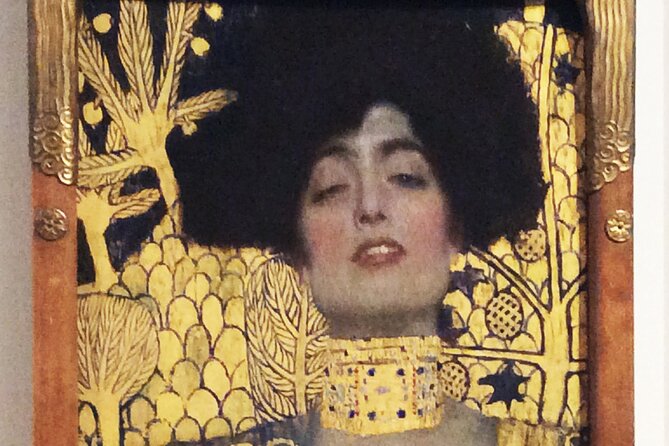
- The Kiss and Judith are the opening stars: You see Klimt’s best-known Golden Period works at the Belvedere.
- The Beethoven Frieze changes the pace: The Secession offers a large, immersive work rather than another framed painting.
- The Leopold Museum fills in the story: Death and Life and a reconstruction of the University of Vienna Ceiling Paintings show Klimt beyond his gold-covered masterpieces.
- Julia is the guide to request by name if available: Her approach connects Klimt’s upbringing, career, Austrian culture, and artistic influence.
- The private format suits serious art lovers: Your own group can ask questions and set the pace within the scheduled visit.
- The tour ends at the Leopold Museum: You can continue through the rest of the museum afterward at your own pace.
Why this three-museum route works
Klimt is easy to reduce to gold leaf, decorative patterns, and The Kiss. This tour gives you a better frame. You begin with his most famous paintings, then move to a building created by the Vienna Secession movement, and finish with works that show his broader interests and changing style.
That sequence matters. At the Belvedere, you see why Klimt became an international favorite. At the Secession, you see how his ideas fit into a larger artistic revolt. At the Leopold, you get a fuller picture of the artist, including work tied to public controversy and his interest in life, death, the body, and symbolism.
The tour lasts about three hours. That is long enough for a serious introduction, but not long enough to cover every Klimt work or every room in the museums. You should think of it as a focused art history lesson with original works in front of you, not a general tour of Vienna’s museums.
The private setup is especially useful here. Klimt’s paintings reward questions about symbolism, technique, patrons, censorship, and Vienna around 1900. With only your own group taking part, you have more freedom to ask why a work matters instead of simply moving from one label to the next.
More Attraction Tickets in Vienna
- Vienna: Classic Ensemble Vienna in St. Peter’s Church Ticket
★ 4.7 · 4,819 reviews - Vienna Kunsthistorisches Museum Day Admission Ticket
★ 4.6 · 3,690 reviews - Vienna: Tickets for Mozarthaus Vienna with Audio Guide
★ 4.2 · 2,344 reviews
Starting at the Upper Belvedere with The Kiss
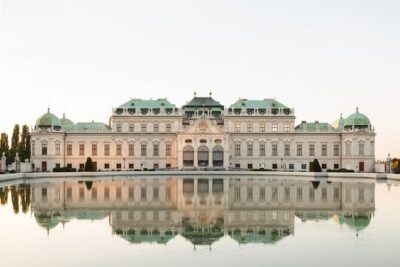
The tour begins at the Austrian Gallery Belvedere, at the main entrance of the Upper Belvedere on Prinz-Eugen-Straße. Be punctual. The meeting point is on the right side of the main entrance, where you can see a striking view over Vienna. If you see the palace but not the city view, you are on the wrong side and should follow the Museum entrance signs around the building.
Your guide will have the museum tickets. That removes one small but useful task at the start, particularly during a busy museum period. The tour information describes skip-the-line entry, though the exact movement through the museum can depend on the conditions that day.
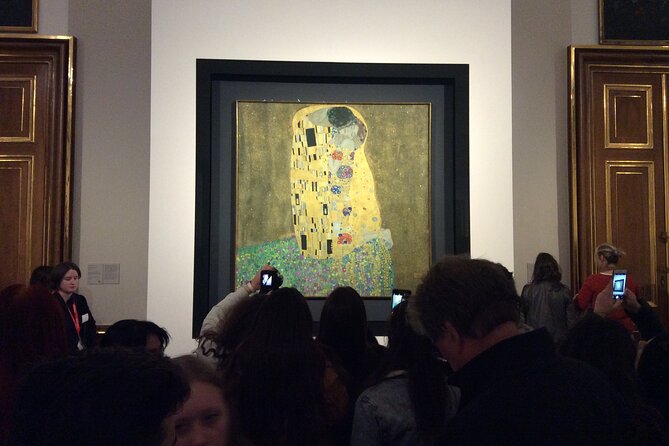
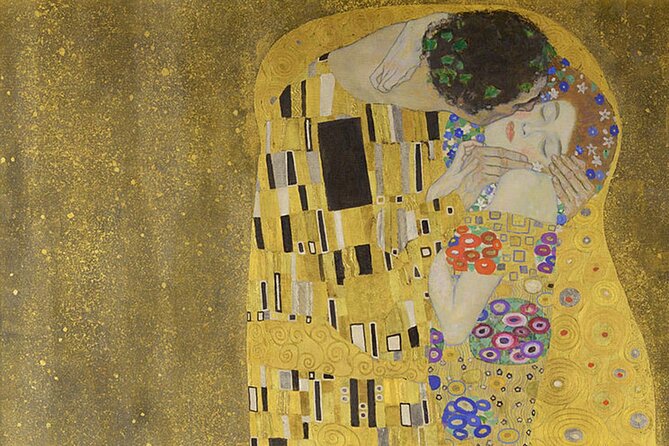
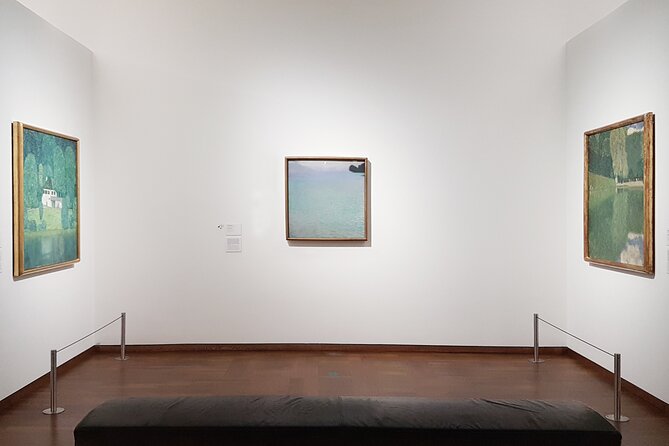
You spend about an hour at the Belvedere. This is the longest stop, and it makes sense. The museum holds The Kiss, Klimt’s famous image of an embracing couple wrapped in patterned gold. You also see Judith, another major work from his Golden Period.
The important point is that these paintings are not simply pretty decorations. A good guide can help you look past the gold and notice the contrast between the figures, the patterns, the poses, and the emotional tone. The gold can make The Kiss seem serene at first glance, but Klimt’s choices leave room for questions about intimacy, desire, possession, and display.
Judith gives you a different mood. The subject comes from the biblical story of Judith, but Klimt presents her with a direct, modern force. Seeing Judith beside The Kiss helps you understand the range of his Golden Period instead of treating it as one repeating style.
This is also the part of the tour where the guide’s art history background matters most. Julia has been praised for explaining Klimt’s upbringing, career, artistic development, and influence in a structured way. Her best quality appears to be her ability to connect the paintings with Austrian culture and the changes taking place in Vienna.
The drawback is crowd pressure. The Kiss is one of Vienna’s most sought-after paintings, and the room may not always feel quiet or spacious. A private guide can explain details, but cannot guarantee that you will have the painting to yourself. Try to stay close enough to hear while still giving yourself a moment to look without commentary.
The Secession Building and the 30-minute Beethoven Frieze
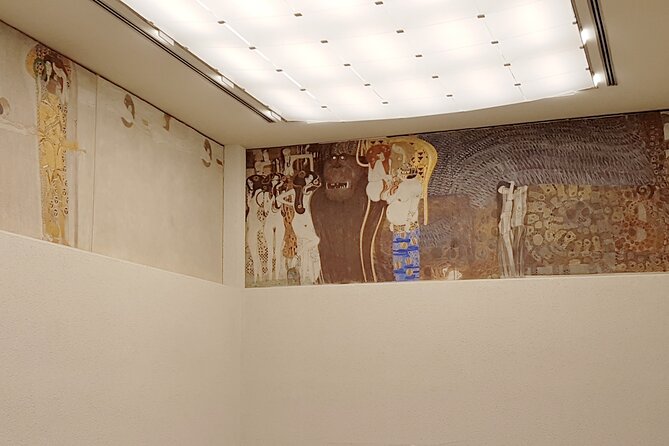
From the Belvedere, the tour continues to the Secession Building, where you spend about 30 minutes with Klimt’s Beethoven Frieze. This stop is shorter, but it adds something the Belvedere cannot: a large work designed as part of an architectural setting.
The Secession itself is closely tied to the artistic movement that broke away from older Viennese institutions. Klimt was one of the leading figures associated with this circle. The building’s unusual exterior already prepares you for a work that does not behave like a standard museum painting.
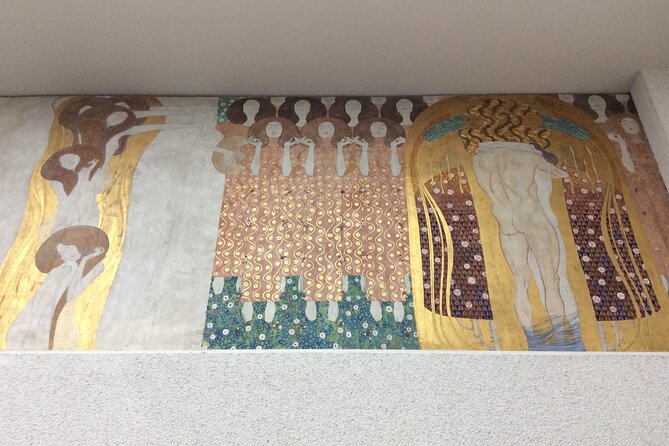
The Beethoven Frieze was created for an exhibition inspired by Beethoven’s Ninth Symphony. It presents a symbolic journey involving longing, danger, temptation, and the search for happiness. The scale changes your relationship with Klimt. Instead of facing one self-contained canvas, you follow images across a wall and experience the work as a sequence.
This is where historical context can turn a confusing work into a readable one. Klimt’s figures, creatures, ornaments, and symbols can seem crowded at first. A guide who explains the themes gives you a route through the imagery and helps you understand why the work was so important to the Secession’s artistic program.
Thirty minutes is enough for a focused explanation, but not an exhaustive study. If the Beethoven Frieze is your main reason for booking, you may wish the visit were longer. Still, the stop works well in the wider tour because it breaks up the succession of famous canvases and shows Klimt working on a much larger scale.
The Secession also gives you a useful change in atmosphere. You move away from the grand palace setting of the Belvedere and into a building made to challenge established ideas. That contrast helps you understand that Klimt was not only a painter of luxurious portraits. He was part of a cultural movement that wanted art to play a larger role in modern life.
The Leopold Museum and Klimt beyond the gold
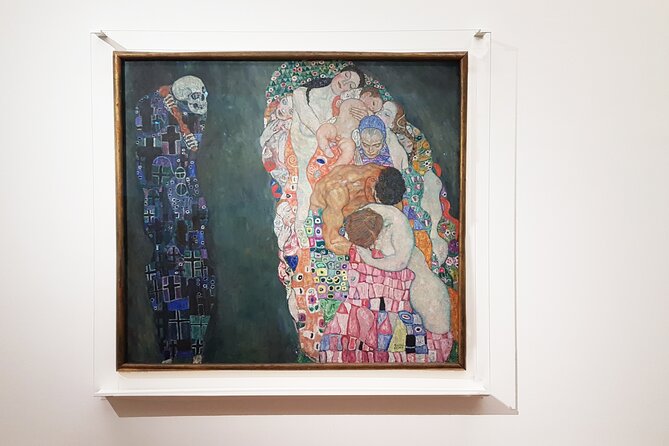
The final major stop is the Leopold Museum in the MuseumsQuartier. You spend about 59 minutes here, looking at Death and Life and a reconstruction of Klimt’s University of Vienna Ceiling Paintings.
Death and Life offers another side of Klimt’s imagination. It sets human existence against the presence of death, using the decorative language associated with Klimt but with a darker and more reflective subject. The work gives your guide a chance to explain recurring themes in Klimt’s art without returning to the familiar romance of The Kiss.
The reconstruction of the University of Vienna Ceiling Paintings is important for understanding Klimt’s career. The original commissions caused major controversy, and the surviving presentation helps you consider why. These works show that Klimt’s ideas could be unsettling when placed in a formal academic setting.
This is a valuable corrective to the popular image of Klimt as a painter of gold-covered couples. His career included ambitious public commissions, intellectual subjects, decorative experiments, and conflicts over what art was expected to show. The Leopold stop helps tie those strands together.
You should allow some energy for this final museum. Three art institutions in one morning or afternoon can be tiring, particularly if you want to listen closely and look carefully. The schedule gives you nearly an hour here, but the tour ends at the Leopold Museum, so you can stay afterward and explore its other exhibitions independently.
That ending is practical. You do not have to leave just as you begin to understand the museum. If you still have time and interest, you can continue on your own without another appointment pressing you toward the exit.
More Hofburg and imperial palace visits:
- Vienna: Skip-the-Line Sisi Museum, Hofburg and Gardens Tour
★ 4.8 · 5,918 reviews - Tickets for the Albertina Exhibitions
★ 4.7 · 2,126 reviews - Vienna: Imperial Treasury in the Hofburg Palace
★ 4.4 · 1,791 reviews - Vienna: Imperial Crypt Entrance Ticket
★ 4.6 · 1,507 reviews
What Julia adds to the experience
The guide is central to this tour. The strongest praise has focused on Julia, who is described as attentive, professional, punctual, and caring. Her explanations apparently link Klimt’s life and career with Austrian culture rather than treating each painting as an isolated object.
That approach suits Klimt. His paintings often need context, but too much academic language can make them feel remote. The best version of this tour gives you a simple thread to follow: Klimt’s upbringing, his development as an artist, his work with the Secession, his Golden Period, his public commissions, and his continuing influence.
Julia’s style has also been praised for being structured and engaging. That matters in three museums. Without a clear order, the experience could become a list of famous titles. With a strong guide, you can see how each stop adds a new piece to the story.
The private format should make the explanations more adaptable. You can ask about a detail in The Kiss, return to a question about symbolism at the Secession, or compare Death and Life with the earlier works. That freedom is difficult to get in a large group.
Guide availability can change, so Julia is not guaranteed unless the booking specifically confirms her. Still, her repeated praise gives you a useful standard: look for a guide who can explain both the visual details and the cultural setting.
Is $336.43 per person good value?
The price is high. At $336.43 per person, you should not book this as a casual museum add-on. The value depends on how much you want interpretation and personal attention.
The fee includes admission to all three museums and a private art historian guide. You are also buying a carefully planned route through three major Klimt locations, rather than arranging separate visits and trying to make sense of the connections yourself.
I would consider it good value for a couple, family, or small group with a strong interest in Klimt, especially if you would otherwise hire a private guide or struggle to understand the symbolism and artistic context. The chance to ask questions is a real benefit.
I would not recommend it for someone who wants to see The Kiss quickly and move on. You can spend far less by visiting museums independently, though you would not receive the same guided structure or private attention.
Group discounts are available, which may improve the price for larger parties. The tour is offered in English, uses mobile tickets, and offers a choice of departure times. Those details make it easier to fit into a Vienna itinerary, but the experience still requires a moderate level of physical fitness.
Timing, meeting details, and practical advice
Plan to arrive early at the Upper Belvedere entrance. The meeting instructions are unusually specific because the palace has more than one side that can look like the obvious entrance. Look for the city view and wait on the right side of the main entrance.
Your guide will be carrying the entry tickets, so keep your confirmation or voucher available in case you need to contact the provider. The meeting point is near public transportation, but the supplied details do not specify a particular route or transfer method between museums. Check your own map and allow enough time to arrive punctually.
A choice of departure times is useful because Vienna’s museums can easily fill a full day. You might schedule the tour before another MuseumsQuartier visit, or use the Leopold Museum’s location as a natural end point for further art viewing.
The experience is offered in English. Since the content is built around art history and cultural context, choose it when you have enough concentration to listen. This is not a quick photo stop. The paintings deserve time, and the explanations are a major part of what you are paying for.
Free cancellation is available up to 24 hours before the start time. Changes or cancellations made within 24 hours are not accepted for a refund, and the cut-off follows local Vienna time.
Who should book this Klimt tour?
I would choose this tour if you:
- Want to understand Klimt’s career rather than see only The Kiss
- Prefer a private guide to a large group
- Enjoy asking questions in museums
- Want the major Klimt works arranged in a clear three-stop story
- Are willing to pay more for interpretation and convenience
- Have about three hours and moderate physical fitness
I would skip it if you prefer to browse silently, have a very limited budget, or want a broad survey of Vienna’s art rather than a Klimt-focused route. You may also find it too concentrated if your interest begins and ends with one famous painting.
Final verdict: a strong choice for serious Klimt fans
This is a focused, expensive, and well-planned introduction to Klimt in Vienna. Its biggest strength is the connection between three very different institutions: the Belvedere for The Kiss and Judith, the Secession for the Beethoven Frieze, and the Leopold for Death and Life and the University of Vienna reconstructions.
I especially like that the tour explains Klimt’s development instead of treating his Golden Period as the whole story. The private setting, skip-the-line admission, and chance to continue at the Leopold afterward add practical value.
Book it if you want art history with your museum visit, and if the price fits your budget. For a casual Klimt stop, visit independently. For an intellectually curious small group that wants to understand why these works matter, this tour earns its place on a Vienna itinerary.
FAQ
How long does the Gustav Klimt tour last?
The tour lasts approximately three hours.
Which museums are included?
The tour includes the Belvedere Museum, the Secession Building, and the Leopold Museum.
Which Klimt paintings can I see?
At the Belvedere, you see The Kiss and Judith. At the Secession, you see the Beethoven Frieze. At the Leopold Museum, you see Death and Life and a reconstruction of the University of Vienna Ceiling Paintings.
Is this a private tour?
Yes. Only your own group participates in the private tour or activity.
Where does the tour begin and end?
The tour begins at the main entrance of the Upper Belvedere, at Prinz-Eugen-Straße 27 in Vienna. It ends at the Leopold Museum in MuseumsQuartier, where you may continue viewing other exhibitions on your own.
What happens if I need to cancel?
You can cancel up to 24 hours before the experience start time for a full refund. Cancellations or changes made less than 24 hours before the start time are not accepted for a refund.
More Skip-the-Line Tickets
- Vienna: Schönbrunn Palace & Gardens Skip-the-Line Tour
★ 4.7 · 7,739 reviews - Vienna: Skip-the-Line Schönbrunn Palace & Gardens Tour
★ 4.8 · 5,411 reviews - Vienna: Bus & Schönbrunn Palace Skip-the-Line Guided Tour
★ 4.3 · 2,802 reviews - Vienna: Skip-the-Line Entrance Ticket to the Danube Tower
★ 4.5 · 2,303 reviews
More Museums
- Vienna: Chocolate Workshop in Chocolate Museum w/ Tasting
★ 4.5 · 1,802 reviews - Sigmund Freud Museum Ticket
★ 4.6 · 1,668 reviews - Vienna: St. Stephen’s Cathedral & Dom Museum Wien Tickets
★ 4.5 · 1,652 reviews - Vienna: Hofburg and Empress Sisi Museum Guided Tour
★ 4.7 · 1,460 reviews
Just added around Vienna
- Mobile puzzle rally tour at the Vienna Central Cemetery★ 4.5 · 3 reviews
- 8 days European Highlights PRIVATE TOUR from Budapest including Budapest Vienna Prague and Bratislava★ 5.0 · 3 reviews
- RAXI (E-Rickschaw) big private Vienna tour★ 4.5 · 3 reviews
- Private Transfer from Vienna to Prague with 1 hour Stop in Kutna Hora★ 4.5 · 3 reviews
- Palais Lobkowitz Audio Guide Tour★ 4.0 · 3 reviews
- Private Tour from Vienna to Melk and Dürnstein★ 4.5 · 3 reviews
- Vienna: Designer Fashion Time Capsule Experience★ 5.0 · 3 reviews
- Vienna Sight & Gourmet Tour – individual private tour★ 4.5 · 3 reviews
Hofburg & Imperial Palaces, compared.

Skip-the-Line Sisi Museum, Hofburg and Gardens Tour
Read our review →

Entry Ticket Upper Belvedere, Klimt’s Kiss & Permanent Collection
Read our review →
Skip-the-Line Hofburg and Empress Sisi Museum Tour
Read our review →
Combo Ticket: Kunsthistorisches Museum & Imperial Treasury
Read our review →Browse the lists this tour appears in